
What Does It Mean to File an Amended Patent Application? Priority vs National Phase Explained
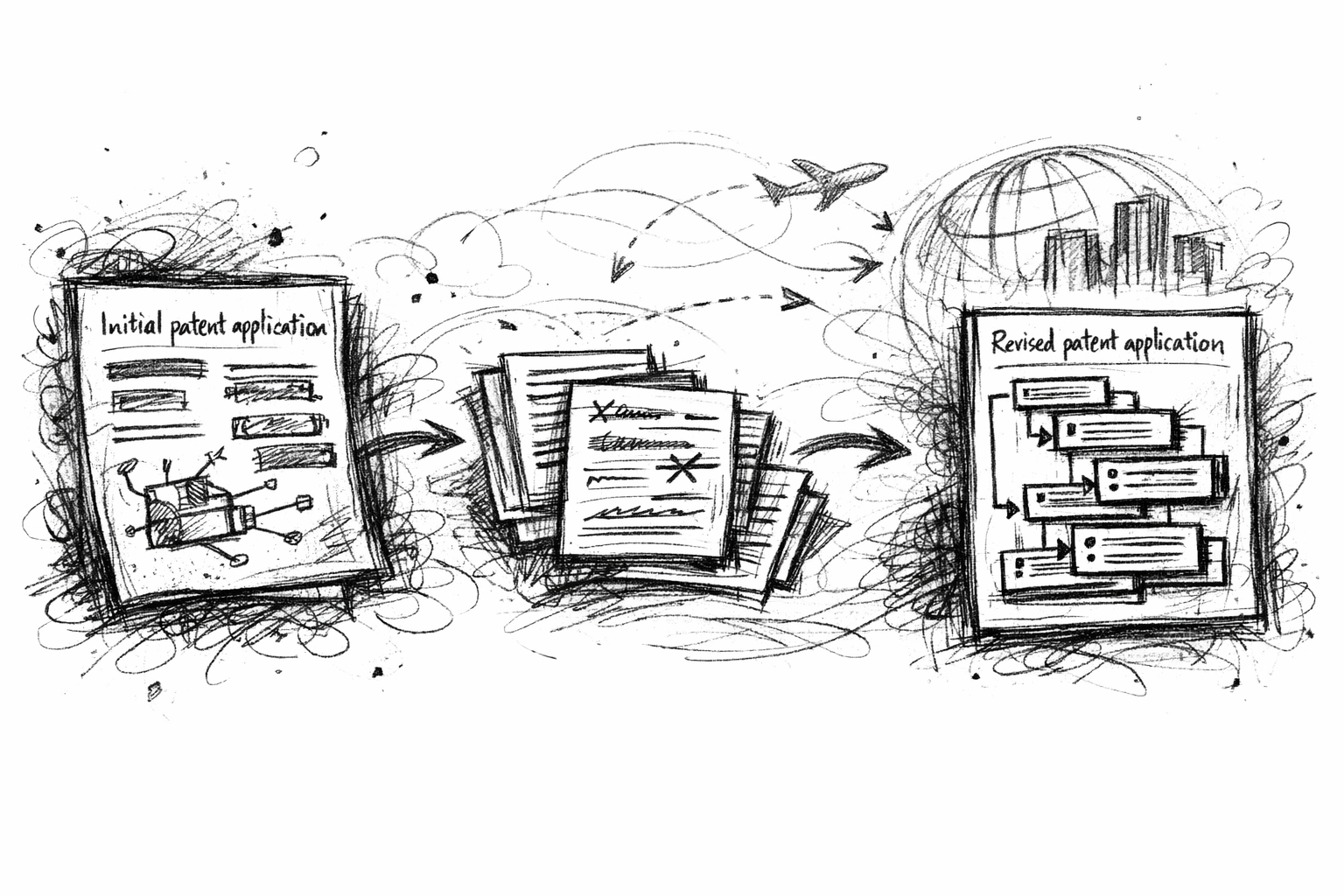
Patent applicants often hear expressions such as “file an amended application,” “enter the national phase with amended claims,” or “make amendments from the priority filing,” yet those phrases are not always used consistently. In practice, they can refer to different procedural steps depending on whether the applicant is still working from the first filing, is already in the PCT stage, or is preparing to enter national phase in individual jurisdictions.
That confusion matters because amendment strategy can shape the strength, scope, and efficiency of an international patent portfolio. A well-timed amendment may reduce objections, improve claim clarity, and position the application more effectively for examination in different countries. A poorly timed amendment, by contrast, can create added matter issues, narrow protection unnecessarily, or force the applicant into inconsistent positions across jurisdictions.
This article explains what it really means to file an amended patent application in an international context, including amendments made from the priority filing, during the PCT phase, and for national phase entry. It also highlights why applicants often take different approaches in jurisdictions such as the United States, Europe, and China.
Table of Contents
- What Is an Amended Patent Application?
- Why Applicants Amend a Patent Application from the Priority Filing
- Amendments During the PCT Phase
- Filing an Amended National Phase Application
- When Should You Amend?
- Risks of Patent Amendments in International Filing
- Timeline of Amendments in International Patent Filing
- Strengthen Your Global IP Strategy with a Smart amendments
What Is an Amended Patent Application?
An amended patent application is not usually a brand-new invention. Rather, it is a revised version of a filing in which some part of the application has been changed in order to define the invention more effectively. In most cases, the amendments affect the claims, although the description and drawings may also be adjusted when procedural rules allow it.
The key point is that amendments are meant to improve how the invention is presented and protected, not to introduce technical subject matter that was never disclosed in the original filing. That distinction is fundamental. In international patent practice, applicants generally have room to refine claim language, clarify support, or reorganize positions for examination, but they cannot freely add new matter without legal consequences.
This is why the phrase “amended patent application” can mean different things depending on context. It may describe a revised set of claims after a search report, a PCT application adjusted under Article 19 or Article 34, or a national phase entry prepared with amendments for local prosecution. In all scenarios, the amendment strategy must remain anchored in the original disclosure.
Key Insight
An amended patent application is usually a refined legal presentation of the same invention, not a second opportunity to disclose new subject matter.
Why Applicants Amend a Patent Application from the Priority Filing
Applicants amend patent applications for both strategic and procedural reasons, and in many cases that process begins much earlier than they expect. It does not start only after an office action or during national phase examination. Very often, the need for amendment can already be traced back to the priority filing, because that first application establishes the technical and legal foundation for the entire patent family.
In practice, applicants amend their patent applications to clarify the invention, improve claim scope, respond to prior art, create fallback positions, or prepare the case for prosecution in multiple jurisdictions. These are not merely corrective measures. In international patent strategy, amendments are often part of a deliberate effort to make the application more resilient before it reaches the PCT stage or national offices.
This is why the priority filing deserves particular attention. If the first application is well drafted, with enough technical detail, alternative embodiments, and properly structured claim support, later amendments are usually easier to implement. The applicant has more room to refine the claims without stepping beyond the original disclosure. By contrast, when the priority filing is too narrow, incomplete, or overly simplified, future amendment options can become much more limited.
That limitation is especially important in international practice. Many applicants assume they will be able to “improve” the application later, but patent law in most jurisdictions does not allow applicants to add new matter freely while preserving the original filing benefits. If a supposedly amended version introduces technical content that was not properly disclosed in the priority application, that subject matter may lose priority support or be rejected altogether. What looks like a routine amendment can therefore become a serious legal weakness.
For that reason, amending from the priority stage is not only a matter of wording. It is a matter of strategy. During the priority year, applicants often review whether the original claims are too broad, whether the description provides enough support for narrower fallback positions, and whether the application is strong enough to support a later PCT filing and eventual national phase entries. Sometimes the best course is not simply to edit the text, but to file a better follow-on application within the priority period if additional disclosure is needed.
Seen this way, the reasons for amendment and the priority-stage strategy are inseparable. Applicants amend because they want stronger, clearer, and more adaptable protection, but the success of that amendment strategy depends heavily on what was disclosed at the very beginning.
Amendments During the PCT Phase
The PCT system gives applicants a valuable opportunity to revise their application before national phase entry. This is one of the reasons the international route is so useful: it creates a procedural window in which the applicant can respond to the search results and adjust the case before it is replicated across multiple jurisdictions.
After the International Search Report, applicants may file amendments under PCT Article 19. These amendments are limited to the claims, but they can still be highly valuable. If the search results reveal that the original main claim is too broad or poorly positioned against the cited art, Article 19 can be used to submit a cleaner claim set before publication and before national offices begin reviewing the application in more detail.
A later and often more strategic opportunity arises under PCT Article 34, during international preliminary examination. At that stage, applicants may amend not only the claims, but also the description and drawings, subject to the applicable rules. This broader amendment mechanism can be especially useful when the applicant wants to improve support language, align terminology, or build a more coherent record before national phase filing.
In practice, many applicants use the PCT stage to create a more mature application for international prosecution. Rather than entering every country with the exact same text that was originally filed, they use the PCT phase to refine the patent application in light of the search results, the likely commercial embodiments, and the likely objections that major patent offices may raise.
For additional information visit our articles:
Key Insight
The PCT stage is often the most efficient point in the process to improve claim positioning before national phase entry begins.
Filing an Amended National Phase Application
The expression “filing an amended national phase application” usually refers to entering the national phase with some form of revised text rather than relying only on the originally filed international application. In other words, the applicant is not simply carrying forward the PCT publication as-is, but is considering whether amendments for national phase entry should be made before or at the moment the case is localized in a particular jurisdiction.
This can happen in different ways. Sometimes the applicant enters national phase using claims that were already amended during the PCT phase under Article 19 or Article 34. In other situations, the applicant prepares local claim amendments specifically for the national phase, where the relevant office allows such amendments on entry or shortly thereafter. In still other cases, the applicant decides to enter with the international text substantially unchanged and wait to amend during local examination.
The right approach depends on both timing and jurisdiction. If the international search results already reveal a clear weakness in the original claims, filing an amended national phase application may help reduce prosecution delays and present a more realistic claim scope from the outset. This is especially valuable when the applicant wants to streamline examination across several important jurisdictions and avoid repeating the same avoidable objections.
At the same time, amendments for national phase entry must be handled carefully because the legal limits are not the same everywhere. The United States is generally more flexible in prosecution and offers procedural mechanisms that often allow applicants to continue refining claims during examination. Europe, by contrast, is well known for its strict approach to added matter, which means that any amendment must have a clear and defensible basis in the application as originally filed. China also requires strategic discipline, because applicants may face more limited room for correction once the case has moved further into the local process.
Additionally, in some jurisdictions, filing an amended national phase application is not only a matter of choosing the right claim set. Applicants may also need to submit the amended text in the format required by the local office, such as a marked-up working copy, annotated pages, or a clean replacement version, depending on local practice. Where the national phase is conducted in a different language, the amended text may also need to be filed together with the relevant translation, and in some cases the office may require both the original and the amended claim text if the applicant wants the amendments to form the basis for examination.
For that reason, filing an amended national phase application is not only a drafting exercise. It is a coordination exercise between the international record, the original disclosure, and the local prosecution strategy. A claim amendment that seems commercially attractive may still be unsuitable if it lacks explicit support, introduces a new combination of features, or creates inconsistency with the way the invention was framed earlier in the patent family.
When Should You Amend?
There is no single answer to the question of timing, because the best amendment strategy depends on the state of the application and the goals of the applicant. Still, as a general rule, the earlier the applicant identifies structural problems in the claim set, the more efficiently those issues can be addressed.
If the invention is commercially stable and the search results clearly indicate which features are likely to support patentability, early amendment can be extremely effective. In that scenario, the applicant may use the PCT phase to create a well-positioned claim set and then file an amended national phase application that is already better suited to examination. This approach can reduce procedural friction and lead to more consistent outcomes across jurisdictions.
On the other hand, there are cases in which waiting makes sense. If the applicant expects different commercial priorities in different countries, or if there is uncertainty about which embodiments will matter most, a more conservative international amendment strategy may preserve flexibility. The applicant can then tailor claims during local prosecution based on the preferences of each office and the evolving business context.
A useful practical distinction is the following:
- amend earlier when the goal is to solve global claim issues efficiently,
- amend later when the goal is to optimize jurisdiction-specific outcomes.
The most sophisticated portfolios often combine both approaches. They use the international stage to remove obvious weaknesses and then rely on targeted local amendments to respond to office-specific standards.
Risks of Patent Amendments in International Filing
Patent amendments can improve a case significantly, but they also create legal and strategic risks if they are not handled with discipline. The most important risk in most jurisdictions is added matter as mentioned previously in this article.
Another common risk is over-narrowing. In an effort to overcome prior art quickly, applicants sometimes add limitations that solve the immediate examination problem but unnecessarily reduce the commercial value of the claims. This becomes even more problematic when that narrowed language is then repeated across multiple jurisdictions, leaving little room for broader protection elsewhere.
There is also the risk of inconsistency across the patent family. International applications are often prosecuted over several years, sometimes with different local counsel in different countries. If amendments are made without coordination, the same invention may gradually be presented in different ways across jurisdictions, making the portfolio harder to manage and potentially more difficult to enforce.
For that reason, centralized coordination can play a critical role in international amendment strategy. When a patent family is being prosecuted in multiple jurisdictions, it is highly valuable to keep track of which amendments were accepted, which objections were raised, and how those changes influenced examination in each office. Even though every patent office applies its own standards, this comparative view can help applicants decide whether a successful amendment in one country should be adapted and replicated elsewhere, or whether a problematic amendment should be avoided in other jurisdictions. A coordinated approach of this kind, such as the support offered through Patentarea’s international prosecution management, can help applicants maintain consistency across the patent family while still respecting local practice.
Timeline of Amendments in International Patent Filing
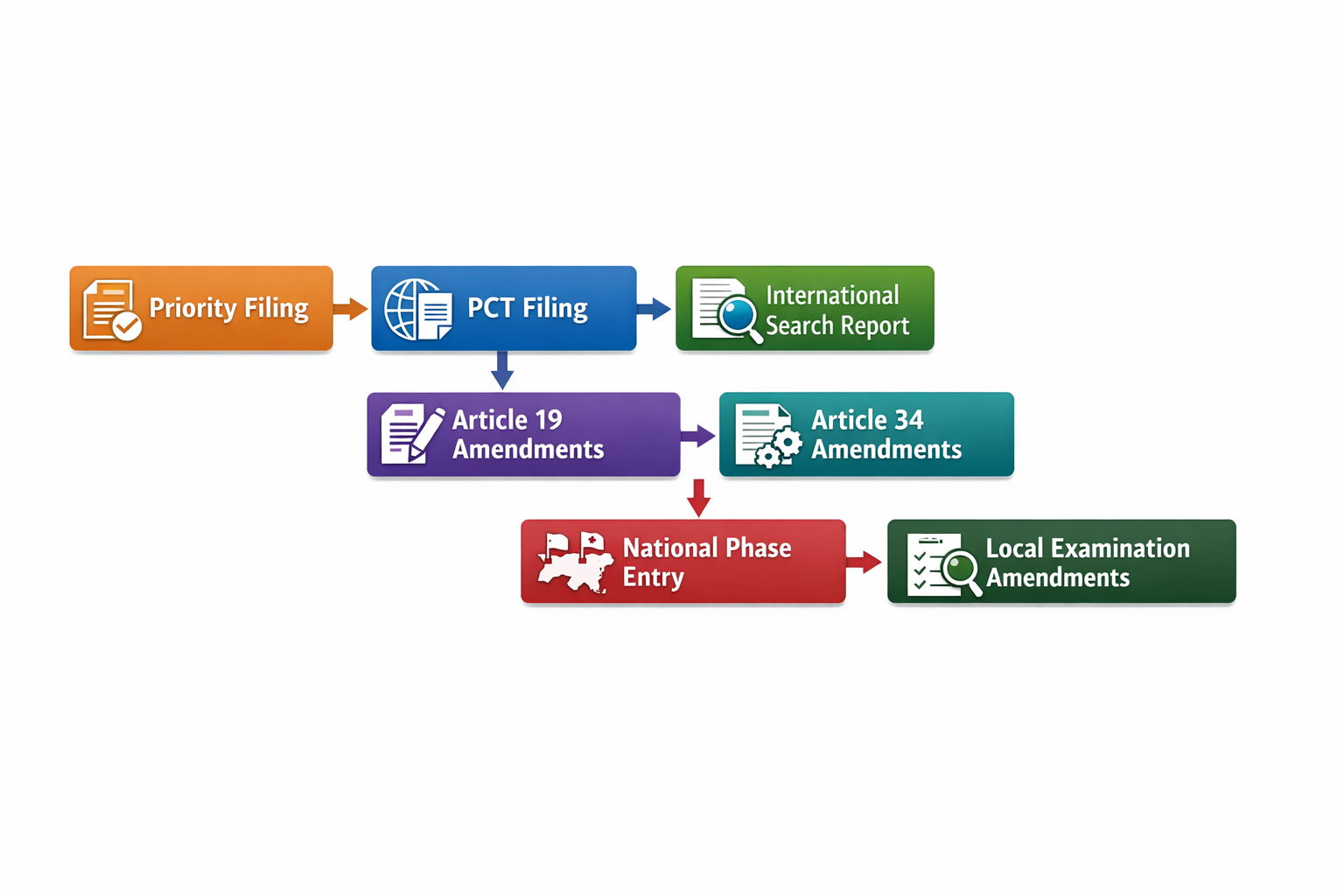
From a portfolio perspective, amendments do not occur at a single moment. They appear in stages, and each stage serves a different purpose. The priority filing establishes the disclosure base. The PCT filing extends the international path. The search report reveals how the claims are likely to be challenged. The PCT amendment stages allow the applicant to react before localization. National phase entry then raises the question of whether local claim refinement should already be made. Finally, local examination creates another opportunity for jurisdiction-specific adjustment.
What matters strategically is that each point on this timeline offers a different level of flexibility. Early stages are better for shaping the family as a whole. Later stages are better for adapting the application to the realities of a specific office.
Strengthen Your Global IP Strategy with a South Korean Patent
Filing an amended patent application is not merely a procedural correction. In international practice, it is a strategic decision that can influence claim scope, prosecution cost, examination efficiency, and long-term enforceability.
Whether the amendment is made from the priority filing, during the PCT phase, or as part of filing an amended national phase application, the central question is always the same: does the amendment improve protection without stepping beyond the original disclosure?
For inventors and IP attorneys managing cross-border portfolios, the most effective approach is usually not to amend at every possible opportunity, but to amend with purpose. A disciplined strategy can help create stronger claims, cleaner prosecution, and a more valuable international patent position.

Get your Patent Filed Now
Contact us today for a free consultation