What Is a DAS Code? A Practical Guide to WIPO Digital Access Service for Patent Applications
When filing patent applications internationally, applicants claiming priority from an earlier application may be required to provide evidence of that first filing. Traditionally, this meant obtaining a certified copy of the earlier patent application and submitting it separately to each patent office.
The WIPO Digital Access Service (DAS) simplifies this process by allowing participating intellectual property offices to exchange priority documents electronically and securely.
For inventors and patent professionals managing filings across several jurisdictions, understanding the DAS Code can help avoid unnecessary paperwork and, more importantly, problems with priority-document formalities.
What is a DAS Code?
A DAS Code, also known as a WIPO DAS access code, is an access code associated with a priority application that has been made available through the WIPO Digital Access Service (DAS).
WIPO DAS is a secure electronic system through which participating intellectual property offices can exchange priority documents. Instead of requiring the applicant to obtain and submit a certified copy of the first application to every subsequent patent office, an office of second filing may retrieve the document electronically through DAS.
The system distinguishes between two roles:
- The Depositing Office, generally the office where the first application was filed, makes the priority document available through DAS.
- The Accessing Office, generally an office where a later application claiming priority is filed, retrieves the document through DAS.
WIPO maintains an updated list identifying which offices participate as Depositing Offices and Accessing Offices, as well as the types of IP rights covered by their participation.
You can consult the official list of participating offices here: WIPO DAS – Participating Offices.
Why Was WIPO DAS Created?
Before electronic priority-document exchange, an applicant filing in several countries might need to obtain multiple certified copies of the same priority application and arrange for those documents to be submitted separately before each patent office.
DAS was designed to simplify this procedure. Once the priority document is properly available through the system, participating offices can retrieve it securely without requiring the applicant to repeatedly obtain and transmit certified copies.
WIPO does not charge applicants for use of the DAS service itself, although individual patent offices may apply their own fees for related services.
When Do You Need a DAS Code?
A DAS Code is relevant when a later patent application claims priority from an earlier application and the applicant wishes the second patent office to retrieve the priority document electronically through WIPO DAS.
For example:
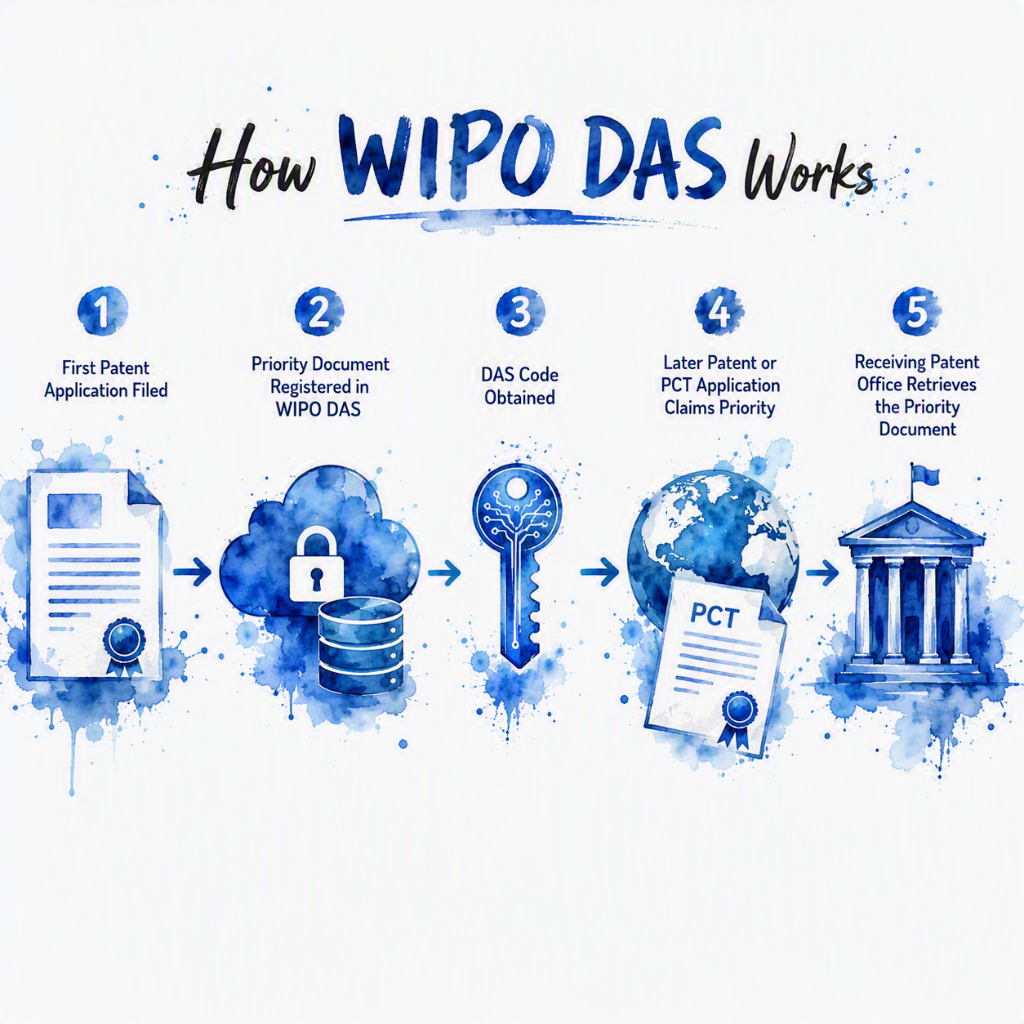
First patent application → Priority claimed in foreign or PCT application → DAS Code provided → Priority document retrieved electronically
The DAS Code does not replace the priority application number, filing date or priority claim. These are separate pieces of information.
This distinction is important:
Priority application number identifies the earlier application.
Priority date identifies when that application was filed.
DAS Code enables an authorized participating office to retrieve the corresponding priority document electronically.
DAS is voluntary, and its availability depends on whether the relevant offices participate in the service for the particular type of intellectual property right involved.
Key Insight
A DAS Code is not a patent application number or a priority right by itself. It is an access mechanism that allows participating IP offices to retrieve the corresponding priority document electronically.
How Do You Obtain a DAS Code and How Is It Used?
How a DAS Code is obtained depends on the patent office where the first application was filed. There is no single procedure that applies to every jurisdiction.
In some countries, the applicant must request that the patent office make the priority document available through WIPO DAS. For example, in Brazil, the INPI uploads the official priority document to the WIPO DAS system after the corresponding request is processed, and an access code is then generated and communicated to the applicant.
Based on our experience, this process may take several weeks in some jurisdictions. Therefore, when a foreign or PCT filing will rely on DAS, it is advisable to request the code sufficiently in advance rather than waiting until the priority deadline is approaching.
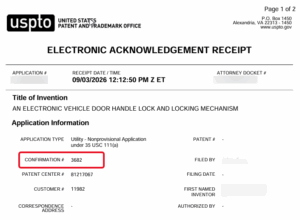
Other patent offices make the process considerably simpler. In the United States, for example, the WIPO DAS access code is the four-digit “Confirmation Number” shown on the USPTO filing receipt and electronic acknowledgement receipt of the U.S. application. When the necessary authorization for electronic access has been provided, this four-digit number can be used by a participating WIPO DAS office to retrieve the U.S. priority application.
Once the priority document has been made available through DAS and the access code is known, the applicant can provide the relevant information to the patent office handling the later application. This normally includes:
- Priority office;
- Priority application number;
- Priority filing date; and
- DAS access code.
Because the procedure for obtaining the code differs from one patent office to another, applicants should check the requirements of the Office of First Filing as early as possible in the international filing process.
DAS Code vs. Certified Priority Document
| WIPO DAS | Certified Priority Document |
| Enables electronic retrieval of the priority document | Is the certified copy of the earlier application itself |
| Retrieved electronically by a participating office | Obtained or submitted through the applicable patent-office procedure |
| Requires compatible DAS participation and procedures | May be required where DAS retrieval is unavailable |
| Reduces repeated document handling | May involve additional formalities, costs, translations, or document delivery |
| Uses the application details and DAS access code | Does not depend on DAS access |
The purpose in both situations is essentially the same: to provide the patent office with an authenticated copy of the application on which the priority claim is based.
The difference lies primarily in how that document reaches the second office.
With DAS, the applicant generally authorizes electronic retrieval. Without DAS, the applicant may need to obtain and submit a certified priority document in accordance with the requirements of the relevant patent office.
Depending on the jurisdiction, filing a certified priority document may also involve additional costs. For example, some patent offices may require a translation of the priority document or of certain parts of it, while other procedures may require the original certified copy to be physically sent to the local attorney or patent office. This can result in additional translation, courier, handling, or local professional fees.
For this reason, where WIPO DAS is available and accepted, it can simplify the process and reduce the administrative burden associated with obtaining, translating, and delivering certified priority documents.
However, DAS does not eliminate certified priority documents from international patent practice. Whether DAS can be used depends on the participating offices, the type of application, and the specific requirements of the jurisdiction where priority is being claimed.
Common DAS Code Problems and How to Avoid Them
Although the DAS system simplifies international patent filing, incorrect information or incomplete registration can cause retrieval failures.
| Common Problem | How to Reduce the Risk |
| Incorrect DAS Code | Copy the code directly from the notification issued by the relevant office |
| Incorrect application number | Use the exact application-number format required for DAS |
| Incorrect priority date | Confirm that the date matches the DAS record |
| Priority document not registered in DAS | Verify that the Office of First Filing has actually made the document available |
| Receiving office does not participate in DAS | Check WIPO’s current list of participating offices |
| Assuming a code automatically satisfies the requirement | Confirm that retrieval was successfully completed |
| Retrieval failure close to a deadline | Check the status early enough to allow an alternative certified copy to be filed if necessary |
A particularly important distinction is between having a DAS Code and having a document successfully available through DAS.
A code alone does not necessarily establish that retrieval will succeed. WIPO’s system cross-checks information such as the priority office, application number, filing date and access code against the registered record. Incorrect information can therefore generate a retrieval error.
Applicants should also verify successful retrieval rather than assuming that submitting the code completes the procedure. The USPTO, for example, specifically advises applicants to monitor the retrieval process and notes that applicants may remain responsible for providing a certified copy when electronic retrieval fails.
The WIPO DAS Applicant Portal can also be useful for monitoring documents associated with a WIPO account, checking availability information and reviewing retrieval activity.
What if the Patent Office Cannot Retrieve the Priority Document?
If an office reports that a priority document could not be retrieved through DAS, the issue should be addressed promptly.
The application number, filing date, office and DAS Code should first be checked against the original priority application and DAS registration. It should also be confirmed that the document has actually been made available through DAS and that the receiving office participates in the appropriate DAS service.
If electronic retrieval cannot be corrected in time, the applicable patent-office rules should be reviewed to determine whether a certified priority document needs to be provided through an alternative procedure.
Simplify Your International Patent Filings with WIPO DAS
The WIPO Digital Access Service has made international priority-document management significantly easier. Instead of obtaining and sending multiple certified copies of the same first-filed patent application, applicants can often authorize participating patent offices to retrieve the document electronically.
However, a DAS Code should always be managed together with the priority claim, priority application number, filing date and applicable deadlines. Participation and procedures also vary between patent offices, so requirements should be confirmed for each filing.
For inventors and companies pursuing protection in multiple countries, properly managing priority documents from the first filing can prevent unnecessary formalities and reduce the risk of problems later in the international patent process.
Patentarea assists inventors, companies and IP professionals with international patent filings, PCT applications, Paris Convention filings and the coordination of priority documents and filing requirements across multiple jurisdictions.

Get your Patent Filed Now
Contact us today for a free consultation