How AI Tools Can Support Patent Drafting: From Prior Art Search to Patent Application Preparation
Artificial intelligence tools are increasingly being used to support technical and documents preparation. In the patent field, these tools may help inventors, startups, companies, and IP professionals organize technical information, compare documents, prepare preliminary drafting materials, and identify potential inconsistencies before a formal patent application is filed.
However, AI-assisted patent drafting should not be confused with professional patent drafting. A patent application is not only a technical document. It is also a legal instrument that defines the scope of protection for an invention. For that reason, the use of AI in patent drafting should be understood as a support mechanism, not as a replacement for technical judgment, patent strategy, or professional legal review.
When used carefully, AI tools may help structure the preparation process. They can assist with summarizing prior art, organizing technical disclosures, proposing preliminary claims, suggesting patent drawings, and drafting initial sections of a patent application. But the quality of the result depends heavily on the quality of the information provided to the tool, the care taken to protect confidential information, and the review performed by a qualified patent professional.
Table of Contents
- AI as a Support Tool in Patent DraftingWhat Is an Amended Patent Application?
- Start with a Prior Art Search
- Building the Right Input for AI Tools
- A Possible AI-Assisted Workflow for Preparing a Patent Draft
- Risks and Limitations of AI-Assisted Patent Drafting
- When to Involve a Patent Professional
- Strengthen Your Patent Strategy with Patentarea
1. AI as a Support Tool in Patent Drafting
AI tools can assist with several tasks involved in patent application preparation. These may include summarizing technical documents, extracting terminology, comparing prior art references, organizing invention disclosures, creating preliminary claim structures, and improving the clarity of draft text.
This can be especially useful at the early preparation stage, when the inventor or company is still organizing the invention and identifying the technical features that may deserve protection. AI may help transform scattered technical notes into a more coherent structure. It may also help detect whether certain elements are missing from the disclosure or whether drawings, claims, and description sections are not fully aligned.
Still, the role of AI should be framed carefully. Patent drafting requires more than describing an invention. It requires defining what should be protected, supporting that scope with a sufficient technical disclosure, and anticipating how the application may be examined by patent offices.
For example, an AI tool may generate a draft claim that appears technically sophisticated, but that claim may be too broad, too narrow, unsupported by the description, or inconsistent with the prior art. Similarly, an AI tool may produce polished text that does not actually improve the legal strength of the application.
For this reason, AI should be treated as a drafting assistant or preparation tool. It can help organize information, but it should not be relied upon as the final authority on patentability, claim scope, filing strategy, or legal sufficiency.
Key Insight
AI tools may help organize and structure patent-related information, but patent drafting remains a technical, legal, and strategic exercise.
2. Start with a Prior Art Search
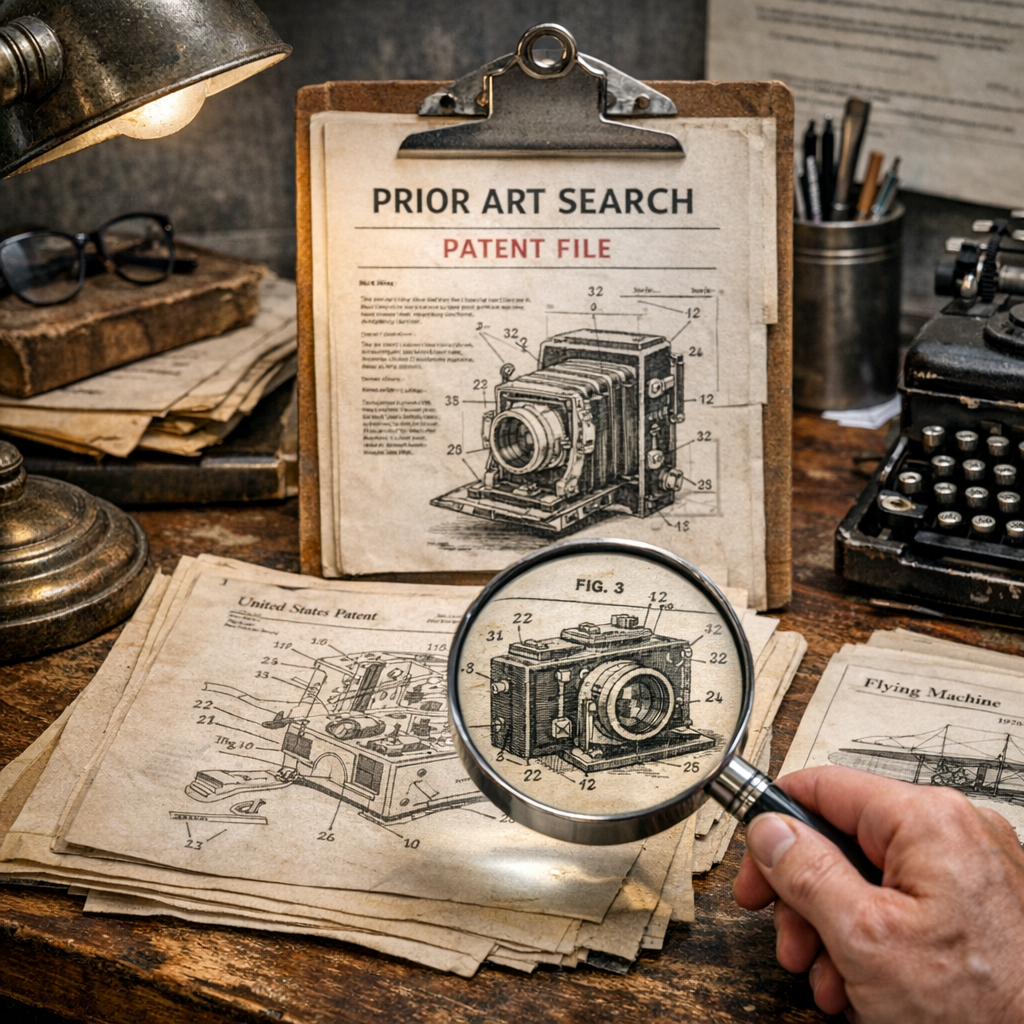
A prior art search is often one of the most useful starting points before preparing a patent application. Prior art may include published patents, patent applications, scientific articles, technical manuals, product documentation, standards, and other publicly available information that relates to the invention.
For AI-assisted patent drafting, a prior art search can be especially valuable because it gives the AI tool context. Without prior art, the tool may generate a generic patent draft that does not clearly distinguish the invention from known technologies. With prior art, the tool can help organize comparisons, identify technical differences, and focus the draft on features that may be more relevant to novelty and inventive step.
Public tools such as Google Patents, WIPO PATENTSCOPE, Espacenet, and national patent office databases can be useful for preliminary searching. They may help identify relevant patent documents, common terminology, CPC or IPC classifications, similar solutions, and examples of how related technologies are described.
However, a basic public search is not always enough. Professional patentability searches are often more complete because they may involve paid databases, advanced search strategies, classification-based searching, family analysis, citation review, non-patent literature, multilingual searching, and technical interpretation of the closest documents.
This distinction is important. Public searches can be useful for orientation, but a professional search may provide stronger support when the invention has commercial value, when a filing strategy is being developed, or when international protection is being considered.
You may review the following articles for additional in formation:
[Patentarea Patentability Search Service]
[How to Conduct a Patent Search in Major Patent Databases Worldwide]
3. Building the Right Input for AI Tools
The quality of AI-assisted patent drafting depends largely on the quality of the input. A vague instruction such as “draft a patent application for my invention” will often produce a generic and unreliable result. A better approach is to provide a structured set of technical and strategic inputs.
Useful inputs may include:
- A technical explanation of the invention, including the problem, the solution, main components, steps, alternatives, materials, configurations, and advantages.
- Relevant prior art documents identified through a preliminary or professional search.
- A comparison between the invention and the closest prior art.
- A list of technical differences that may support novelty or inventive step.
- Examples of granted patents or published applications in the same technical field, used only as structural references.
- Preliminary sketches, diagrams, flowcharts, or informal drawings.
- A glossary of preferred technical terms.
- Notes about what information should remain confidential and should not be entered into unsecured AI tools.
Using granted patents or published patent applications as references can be helpful, but the purpose should not be to copy text. Instead, these documents can help show how similar technologies are structured, how figures are described, how embodiments are organized, and how technical language is commonly used in the field.
It is also important to avoid overwhelming the AI tool with too many documents. A carefully selected group of relevant references, combined with a clear technical disclosure, is often more useful than a large folder of unorganized files. For example, three to five close prior art references, a comparison table, and a concise invention memo may provide a stronger foundation than dozens of unrelated patent documents.
The AI tool can then be asked to compare documents, extract terminology, identify possible claim elements, suggest figures, or organize the technical disclosure. But every output should be checked against the original invention disclosure and the prior art.
Key Insight
AI tools are more useful when they receive complete technical information, relevant prior art, and carefully selected structural references
4. A Possible AI-Assisted Workflow for Preparing a Patent Draft
AI-assisted patent drafting is best understood as a possible workflow, not a mandatory formula. The following sequence can help organize the preparation of a draft, but it should not be confused with the formal order required by a specific patent office.
A practical workflow may begin with the identification of the invention’s core technical features, then move toward drawings, figure descriptions, detailed description, and finally the remaining sections of the patent application.
4.1 Preliminary Claims
One useful application of AI is the preparation of preliminary claims. These claims should not be treated as final claims ready for filing. Instead, they can serve as a working tool to identify the essential elements of the invention.
Starting with preliminary claims can help clarify what the invention is really about. It may force the inventor or drafting team to define the main components, method steps, technical relationships, and optional features that may be important for protection.
For example, if the invention relates to a device, preliminary claims may help identify the essential structural elements and how they interact. If the invention relates to a method, preliminary claims may help organize the sequence of steps. If the invention relates to software or AI technology, preliminary claims may help distinguish between data inputs, processing operations, outputs, and system architecture.
AI can help transform a technical explanation into a first claim structure. However, those claims must be reviewed carefully. A claim generated by AI may include unsupported features, unnecessary limitations, or overly broad language. It may also fail to capture the commercially important aspect of the invention.
Preliminary claims should therefore be treated as a map for further discussion, not as a substitute for professional claim drafting.
4.2 Suggested Patent Drawings
Once the preliminary claim structure is available, AI can help suggest which drawings may be useful to represent the invention.
Depending on the technology, suggested drawings may include: A general system diagram, a block diagram, a flowchart, a perspective and exploded views among others.
This can be a valuable step because drawings often help clarify the invention before the detailed description is written. A good set of figures can make the patent application easier to understand and can provide support for different embodiments and claim features.
At this stage, AI may be used to create a preliminary list of figures and describe what each figure should show. That list can then be reviewed by the inventor, patent drafter, or technical illustrator before formal patent drawings are prepared.
4.3 Brief Description of the Drawings
After the drawings are defined, AI can assist with preparing the “Brief Description of the Drawings” section.
This section usually provides a short explanation of each figure. It should be clear, consistent, and neutral. For example, it may state that Figure 1 illustrates a schematic view of a system, Figure 2 illustrates a flowchart of a method, or Figure 3 illustrates an example embodiment of a component.
AI tools can be useful here because this section often requires consistency more than creativity. The tool can help ensure that each figure is described in a similar style and that the terminology used in the brief description matches the terminology used in the rest of the application.
However, this section should generally avoid unnecessary technical limitations or unsupported advantages. It is usually better to keep the brief description concise and leave the detailed technical explanation for the detailed description.
4.4 Detailed Description Based on the Figures
The detailed description is one of the most important parts of the patent application. It explains how the invention works, how the elements interact, what embodiments are contemplated, and how the claims are supported.
AI may help convert sketches, notes, diagrams, and component lists into more organized paragraphs. For example, if the inventor provides a numbered figure showing a sensor, processor, interface, housing, and communication module, AI can help draft paragraphs explaining how those components interact.
This can save time in preparing an initial draft. It can also help check whether every numbered element in the drawings is described in the text.
However, the detailed description must be based on real technical information. AI should not invent materials, dimensions, ranges, steps, advantages, or embodiments that were not disclosed by the inventor. If the tool fills gaps with generic assumptions, those assumptions must be identified and reviewed.
A useful approach is to ask the AI tool to flag any sentence that appears to be an inference or that may require support. This can help the drafting team separate confirmed technical information from material that needs further review.
4.5 Remaining Patent Application Sections
After preliminary claims, drawings, brief figure descriptions, and detailed description are in place, AI can help prepare or refine the remaining sections of the application and do a Cross-checking between claims, drawings, and description.
The background section requires special care. AI tools may overstate what is known in the prior art or use language that unintentionally admits that certain features are conventional. Similarly, the summary section should not unnecessarily limit the invention. The abstract should be concise and should reflect the disclosure without replacing the legal function of the claims.
AI can assist with structure, clarity, and consistency, but these sections should still be reviewed from a patent strategy perspective.
5. Risks and Limitations of AI-Assisted Patent Drafting
The use of AI in patent drafting presents important risks. These risks should be addressed openly, especially when the article is directed to inventors and companies that may be tempted to rely too heavily on automated tools.
One major risk is technical inaccuracy. AI tools can generate text that appears confident but is incomplete, unsupported, or incorrect. In patent drafting, this can be problematic because inaccurate language may affect the scope, clarity, or enforceability of the application.
Another risk is unsupported subject matter. A patent application generally needs to provide sufficient support for the claimed invention. If an AI tool adds features that were not actually disclosed by the inventor, those features may create problems later. They may not be usable in claims, or they may create inconsistencies in the application.
AI tools may also produce claims that are too narrow or too broad. A narrow claim may fail to protect the commercial value of the invention. A broad claim may be difficult to defend against prior art. In both cases, the issue is not merely stylistic. It can directly affect patent value.
Confidentiality is another major concern. Before uploading an invention disclosure, unpublished technical information, drawings, source code, test data, or commercial details into an AI platform, users should understand how the tool handles data. Important questions include whether the data may be stored, reviewed, used for training, transferred to third parties, or processed in another jurisdiction.
In some cases, the use of external AI tools may also raise legal, ethical, export control, or professional responsibility concerns. This is especially relevant when attorneys, patent agents, companies, or research institutions handle confidential or sensitive technologies.
For these reasons, AI-assisted patent drafting should include a careful review of accuracy, support, consistency, confidentiality, and provider terms.

6. When to Involve a Patent Professional
AI tools may be useful in the preparation stage, but there are many situations where professional patent support becomes especially important.
A patent professional should be involved when the invention has commercial value, when a product launch is planned, when investors are involved, when international filing is being considered, or when the prior art appears close. Professional review is also important when the technology is complex or when the inventor has limited experience with patent drafting.
A patent attorney, patent agent, or specialized patent drafting team can help evaluate whether the draft properly supports the claims, whether the claims capture the commercially relevant features, whether the background section creates unnecessary admissions, and whether the drawings and description provide enough detail.
Professional support can also help define a filing strategy. For example, the approach may differ depending on whether the applicant plans to file first in one country, use the PCT system, claim priority abroad, pursue multiple jurisdictions, or protect different aspects of the invention through different claim sets.
This is the point where AI preparation and professional strategy can work together. The inventor may use AI to organize materials, summarize prior art, and prepare a more complete disclosure package. The professional can then use that material to review patentability, refine the claims, correct weaknesses, and prepare a stronger application.
Strengthen Your Global IP Strategy with a AI tools
Filing an amended patent application is not merely a procedural correction. In international practice, it is a strategic decision that can influence claim scope, prosecution cost, examination efficiency, and long-term enforceability.
Whether the amendment is made from the priority filing, during the PCT phase, or as part of filing an amended national phase application, the central question is always the same: does the amendment improve protection without stepping beyond the original disclosure?
For inventors and IP attorneys managing cross-border portfolios, the most effective approach is usually not to amend at every possible opportunity, but to amend with purpose. A disciplined strategy can help create stronger claims, cleaner prosecution, and a more valuable international patent position.

Get your Patent Filed Now
Contact us today for a free consultation