How Patent Drafting Can Affect the Protection of a Revolutionary Invention
Many inventors believe that a truly revolutionary invention will naturally receive strong patent protection. Unfortunately, patent law does not reward innovation based solely on scientific significance.
An invention may be supported by years of research, validated through experiments, published in respected scientific journals, and even granted a patent in another jurisdiction. Yet it may still receive novelty or obviousness rejections, or ultimately obtain only narrow patent protection because of one fundamental issue:
the patent application was not drafted properly.
The strength of a patent is determined not only by the quality of the invention but also by how effectively the invention is described and claimed.
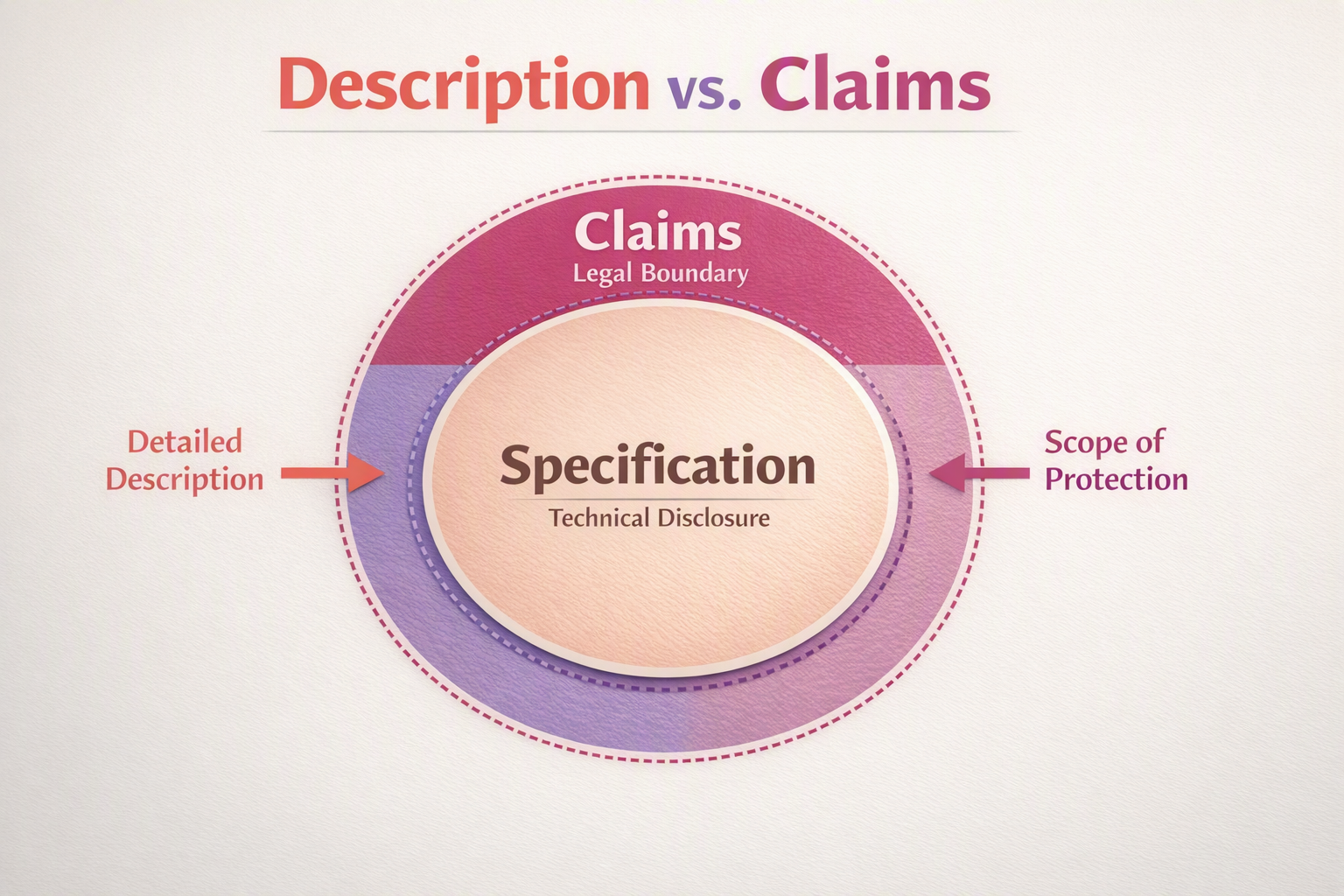
International organizations such as WIPO emphasize that while the specification teaches others how to make and use the invention, the claims define the boundaries of protection.
For this reason, patent drafting should never be treated as a simple administrative task. It is one of the most strategic phases of the entire patent process.
Key Insight
A revolutionary invention is only as strong as the patent application that protects it.
Table of Contents
- Why Revolutionary Inventions Can Still Receive Patent Rejections
- The Difference Between Explaining an Invention and Claiming It
- How Poor Patent Drafting Leads to Prior Art Rejections
- Why It Is Often Too Late to Fix Drafting Problems During Examination
- Practical Case Study: When Great Science Meets Weak Patent Drafting
- Best Practices for Drafting Strong Patent Applications
- Strengthen Your Global IP Strategy with Professional Patent Drafting
1. Why Revolutionary Inventions Can Still Receive Patent Rejections
Many inventors are surprised when they receive prior art rejections after developing technology that appears significantly more advanced than anything previously available.
The explanation is relatively simple.
Patent examiners do not compare scientific merit.
They compare the language of the claims against the prior art.
Even when the invention itself represents a major technological breakthrough, the examiner can only evaluate the features that actually appear in the claims.
This principle is particularly important in the United States, where patentability depends heavily on compliance with 35 U.S.C. §112, including:
Written Description
Enablement
Definiteness
Courts have repeatedly explained that inventors must demonstrate possession of the claimed invention at the filing date.
If applicants attempt to claim more than they actually teach, those claims may fail.
European practice reaches similar conclusions through Articles 84 and 123(2) EPC, requiring essential technical features to appear in the claims and prohibiting the addition of subject matter after filing.
Consequently, scientific excellence alone cannot compensate for weak patent drafting.
Readers who want broader context before diving deeper into drafting strategy can start with Patentarea’s Complete Guide to Invention Patents, then return to this article for the narrower question of why drafting often determines whether a breakthrough is protected broadly, narrowly, or not at all.
Key Insight
Patent law protects what is properly disclosed and claimed—not simply what is scientifically impressive.
2. Explaining an Invention Is Not the Same as Claiming It
One of the most common misunderstandings among inventors is believing that explaining an invention thoroughly automatically results in broad patent protection.
It does not.
A patent specification serves two distinct purposes.
The specification teaches.
The claims define legal rights.
Inventors often provide:
- scientific theory
- experimental results
- publications
- performance comparisons
- engineering discussions
While these materials are valuable, they do not define patent scope unless the distinguishing technical features are reflected in the claims.
This distinction becomes critical during examination.
Patent examiners generally compare the pending claims, not the inventor’s scientific publications, to the cited references.
If an applicant argues:
“Our invention uses a unique optical arrangement.”
but that feature does not actually appear in the claims, the argument usually carries little weight.
Simply put:
You cannot rely on unclaimed features to overcome prior art.
That is also why polished drafting is a strategic discipline rather than a formality. Patentarea’s Patent Drafting Full Guide is a natural companion piece here because the core challenge is not writing more words; it is writing the right legal words so the inventive concept appears in the claim set, supported by the specification, before prosecution hardens.
3. How Poor Patent Drafting Creates Prior Art Problems
Poor drafting rarely involves obvious mistakes.
Instead, it usually reflects a mismatch between the true inventive concept and the legal language used to define it.
Several drafting problems repeatedly lead to unnecessary rejections.
Overly Broad Claims: Broad claims may inadvertently cover technologies already disclosed in the prior art. Instead of distinguishing the invention, the claim becomes broad enough to read directly on earlier references.
Missing Essential Technical Features: Sometimes the inventor knows exactly what makes the invention unique. Unfortunately, those distinguishing features remain buried in the description rather than incorporated into the claims.
During examination, this often leads to arguments that the cited reference lacks an important characteristic, only for the examiner to respond that the characteristic is not recited in the claims.
Relative or Ambiguous Language: Expressions such as:
- much smaller
- optimal
- substantially improved
- conventional
- impossible
can create uncertainty unless they are supported by measurable technical parameters.
Functional Claiming Without Adequate Support: Claims that define an invention only by what it accomplishes, rather than by how it achieves that result, may trigger written description or enablement issues if the specification does not adequately support the claimed scope.
Key Insight
Prior art often becomes a problem not because the invention lacks novelty, but because the claims fail to express its true technical distinction.
4. Why It Is Difficult to Repair Drafting Problems During Examination
Many inventors assume that any deficiencies can simply be corrected once the USPTO issues an Office Action.
Unfortunately, patent prosecution offers limited opportunities to introduce new concepts.
Once the application has been filed, applicants generally cannot add technical information that was not originally disclosed.
This limitation arises from the prohibition against introducing new matter.
Similarly, amendments must remain fully supported by the original specification to satisfy the written description requirement.
This creates a common dilemma.
The inventor suddenly realizes that the real inventive concept should have been described differently.
However, if that improved explanation was never included in the original filing, it may be impossible to amend the claims accordingly.
The result is often a difficult strategic decision:
- Maintain broad claims and risk rejection.
- Narrow the claims significantly.
- File continuation or follow-on applications where appropriate.
- Pursue appeal or continued examination.
None of these options is as effective as having a well-drafted application from the beginning.
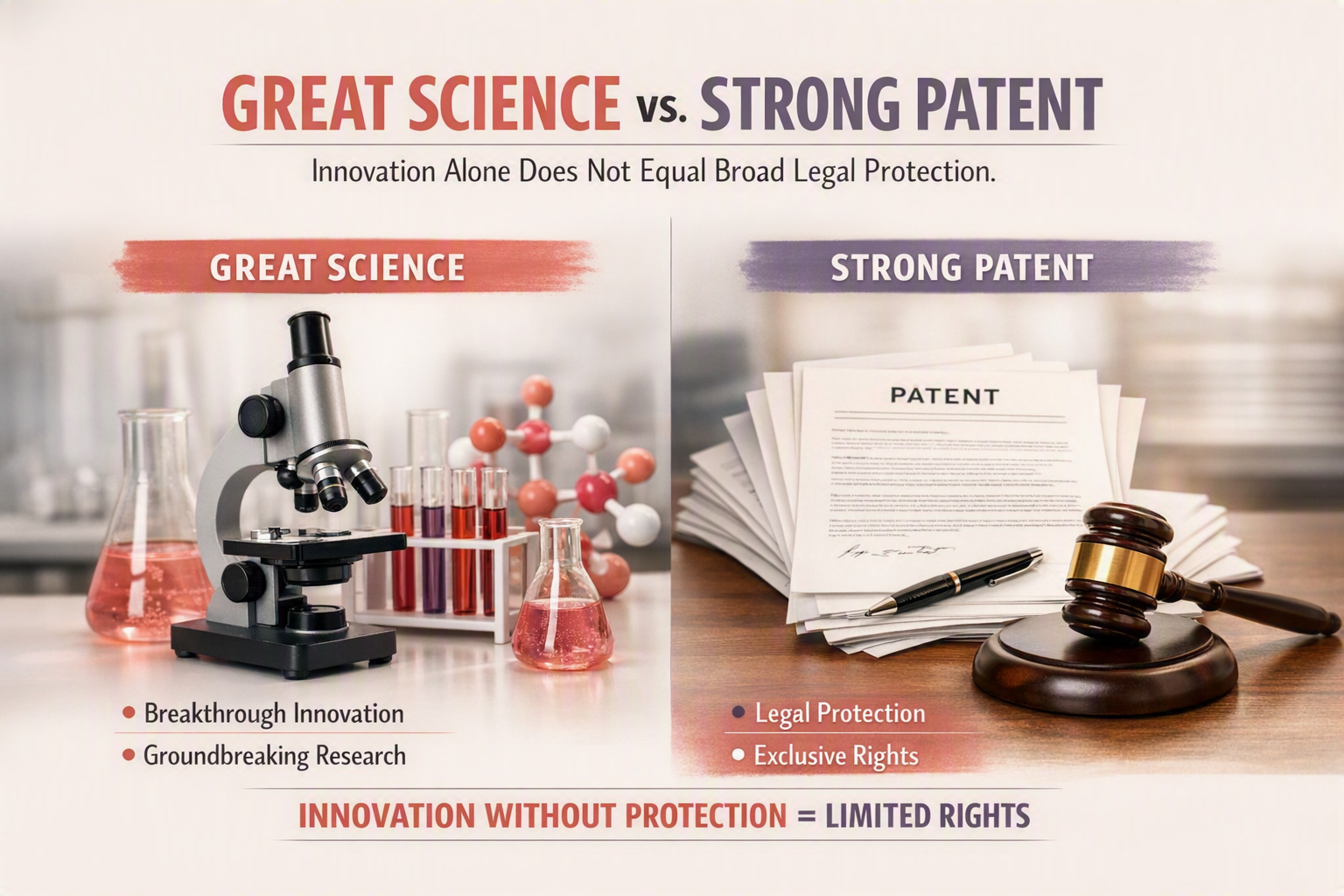
5. Practical Case Study: When Great Science Meets Weak Patent Drafting
Consider the following anonymized scenario inspired by an actual prosecution history.
An inventor developed an innovative X-ray imaging technology supported by:
- years of scientific research,
- peer-reviewed publications,
- experimental validation,
- and a granted Chinese patent.
Despite these accomplishments, the corresponding U.S. application received repeated prior art rejections.
The examiner’s position was not that the invention lacked technical merit.
Instead, several distinguishing technical features relied upon by the inventor during prosecution:
- specific optical arrangements,
- mathematical processing techniques,
- micrometer-level resolution,
- unique structural relationships,
were either:
- absent from the claims, or
- insufficiently supported in the original specification to permit later amendment.
As prosecution continued, the inventor developed a clearer understanding of the invention’s true inventive concept.
Unfortunately, much of that refined explanation could no longer be incorporated into the application without raising written description or new matter concerns.
The lesson is straightforward.
The invention itself was not necessarily the problem.
The legal drafting failed to capture its most important technical contribution at the time of filing.
6. Best Practices for Drafting Strong Patent Applications
High-quality patent drafting begins long before filing.
Experienced patent professionals typically work with inventors to identify not only how the invention works, but also exactly what differentiates it from the closest prior art.
A robust drafting strategy generally includes:
- Clearly identifying the inventive concept.
- Defining the closest known technology.
- Drafting multiple claim layers with fallback positions.
- Including alternative embodiments.
- Supporting important parameters, ranges, and technical relationships.
- Providing sufficient examples that support broad claim scope.
- Avoiding ambiguous terminology.
- Considering drafting strategies suitable for multiple jurisdictions.
Strong drafting also anticipates future prosecution.
Rather than preparing only one broad claim, skilled practitioners often develop a structured claim hierarchy that allows meaningful amendments without introducing new matter.
This flexibility can dramatically improve prosecution outcomes.
Strengthen Your Global IP Strategy with Professional Patent Drafting
A revolutionary invention deserves more than scientific recognition—it deserves enforceable patent protection.
Effective patent drafting transforms technical innovation into legally defensible intellectual property by ensuring that the specification fully supports the invention and that the claims accurately define its commercial value.
Whether filing first in the United States, Europe, China, or through the Patent Cooperation Treaty (PCT), early drafting decisions often determine the ultimate strength of your patent portfolio.
At Patentarea, we work with inventors, research institutions, startups, and IP professionals worldwide to prepare strategically drafted patent applications that maximize protection across multiple jurisdictions.
Because in patent law, innovation alone is not enough.
The way you draft your patent application can determine the value of your invention for decades to come.

Get your Patent Drafted Properly
Contact us today for a free consultation