Patent Filing in the United Kingdom: A Comprehensive Guide to the UK Patent Application Process
Filing a patent in the United Kingdom can provide up to 20 years of protection for a qualifying invention, provided the patent is granted and the required renewal fees are paid. UK patents are administered by the UK Intellectual Property Office (UKIPO) under the Patents Act 1977. Applicants seeking broader international protection may also obtain UK coverage through the Patent Cooperation Treaty (PCT) or through the European Patent Office (EPO).
Choosing the right filing route depends primarily on where protection is required, whether an earlier priority application exists, and how quickly the applicant needs to commit to national filing costs. A direct UK application is often the most straightforward option when the United Kingdom is the principal market, while the PCT route gives applicants additional time before entering individual jurisdictions. The European route can be attractive when protection is sought in the UK together with several other European countries.
Eligibility and Filing Routes
To receive a UK patent, an invention must be new, involve an inventive step, be capable of industrial application, and not fall within one of the statutory exclusions. Certain subject matter, including discoveries, mathematical methods, business methods and computer programs “as such,” may be excluded from patentability.
A normal UK patent application should ultimately contain a description, one or more claims, an abstract and any necessary drawings. The description must explain the invention sufficiently, while the claims define the legal scope of protection sought. UKIPO specifically warns that completely new technical matter normally cannot simply be added after filing, so the initial specification should be prepared carefully.
There are three principal routes to UK patent protection:
| Route | Timeline to grant | Indicative cost range | Pros / Cons |
| Direct UK national application | Ordinary cases often take several years; a current professional guide uses approximately 4–6 years, while UKIPO’s June 2026 examination performance shows significant backlog. | Minimum UKIPO fees £405 (about €474 / US$548) with no excess claims/pages. Attorney drafting/filing commonly runs into several thousand pounds; full prosecution can reach £10,000–£22,000+ depending on complexity. |
Pros: direct, relatively low official fees, good for UK-focused protection. Cons: protects only the UK market and requires its own prosecution. |
| PCT → UK national phase | UK phase must normally be entered by 31 months from priority; UK search/examination then follows, so grant may take several additional years. | Basic UKIPO entry/search/exam fees are approximately £330–£370 (about €386–€433 / US$447–US$501), excluding excess fees, translations, attorney charges and earlier PCT costs. |
Pros: delays national decisions and fits international portfolios. Cons: more expensive overall because the international phase has already incurred separate costs. |
| European patent designating UK | No separate UK grant stage: UK effect follows the EPO grant. For context, EPO standard cases averaged 24.2 months from the beginning of substantive examination to grant in 2025. | £0 UK post-grant translation/validation fee; EPO application, prosecution and subsequent renewal costs are separate. |
Pros: one EPO examination can produce protection in multiple EPC states; UK post-grant formalities are minimal. Cons: substantially greater European-route costs if the applicant only needs the UK. |
Filing Process, Deadlines and Costs
The normal direct UK process can be summarised in a few practical steps.
Prepare the application. The specification should contain a detailed description, claims defining the desired protection, an abstract and drawings where appropriate. UKIPO emphasizes that the claims are the legal statements defining what the applicant wants protected and recommends professional assistance where there is doubt about claim drafting.
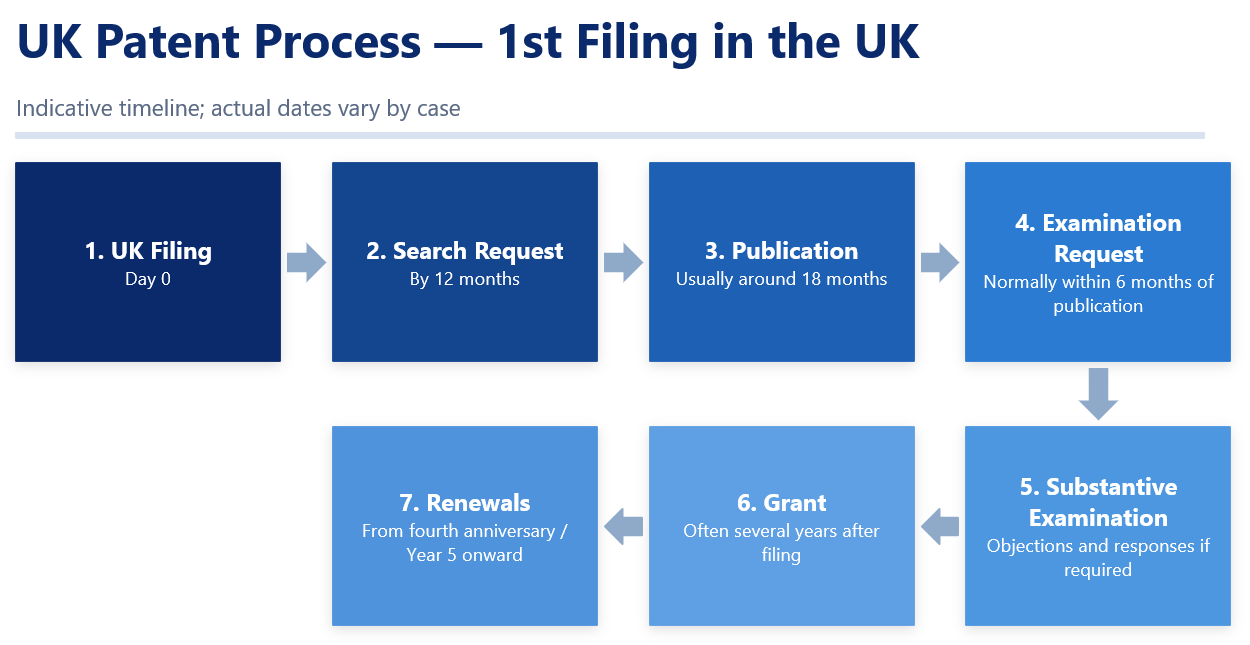
File at UKIPO. The 2026 online filing fee is £75 when paid at filing. Paying the application fee later increases the online fee to £95. Search and examination charges are separate.
Request the search. A UK search normally must be requested within 12 months of filing. The current online search fee is £200, plus £27 for each claim over 25. UKIPO says a search report will normally be produced within approximately six months of the request.
Publication. A complete direct UK application is normally published at approximately 18 months. Publication makes the application and much of its file publicly accessible; it does not mean that a patent has been granted.
Request substantive examination. Examination is not automatic and generally must be requested within six months after publication. The current online fee is £130, plus £13 for each description page over 35 pages. The examiner assesses novelty, inventive step, disclosure and other statutory requirements and may issue objections requiring amendments and written responses.
The minimum direct UKIPO fees for an ordinary online application with no excess claims or pages are therefore £405: £75 filing + £200 search + £130 examination. This is approximately €474 or US$548 at the reference exchange rates used for this guide.
You may review all official fees in the following link:
[UK Patent Office Official Fees]
Professional fees are separate. Published UK attorney pricing currently ranges from approximately £2,000–£6,000 plus VAT for preparing and filing at one practice, while another current guide estimates £6,500–£8,000 just for drafting a standard mechanical patent specification and £15,000–£22,000 plus VAT for taking an ordinary-complexity UK patent through the overall process.
At Patentarea we strive to maintain competitive prices. For a quotation, do not hesitate in [contacting us].
Priority is particularly important for international applicants. When a first patent application has already been filed elsewhere, a subsequent UK application will normally need to be filed within 12 months to claim the earlier application’s priority. UK law provides limited procedures for certain late priority claims, including circumstances involving an application filed within two months after the normal period, but applicants should not plan around these exceptions.
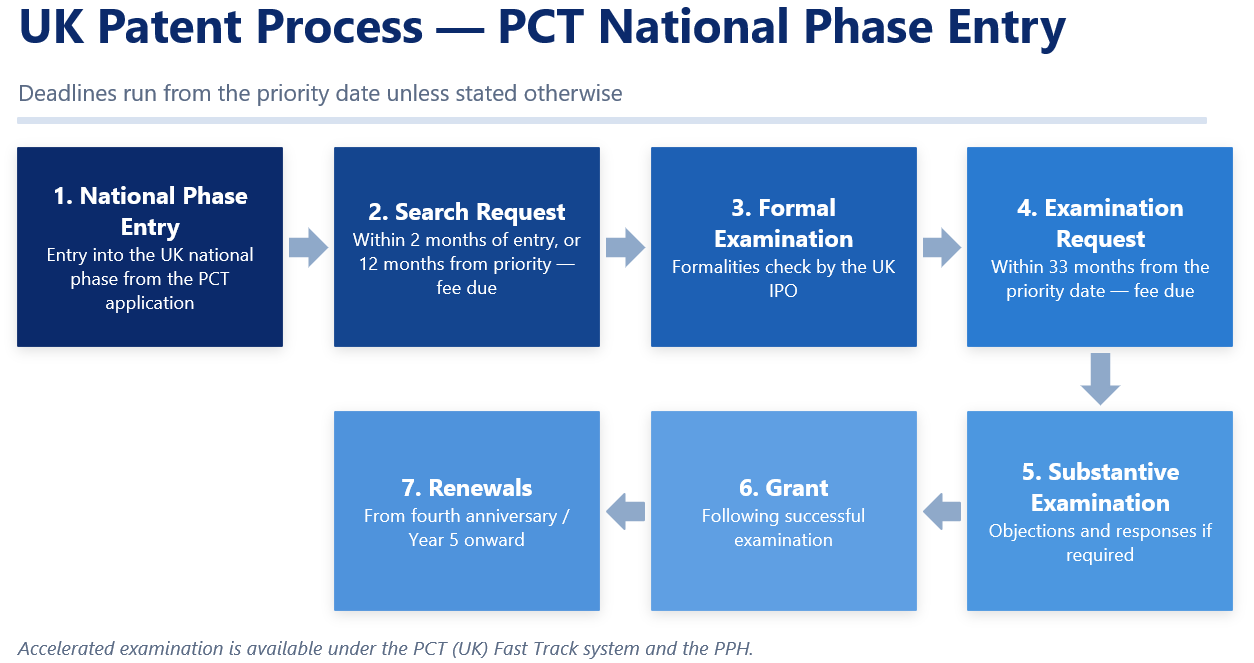
For a PCT application, the UK national phase must normally be entered by 31 months from the priority date, or 31 months from the international filing date when no priority is claimed. If the international application was not filed or published in English, an English translation is required. The UK national-phase fee is £40; the online search is £160 where the application has already been internationally searched, otherwise £200, and online substantive examination is £130, before excess fees.
A simplified direct-UK timeline looks like this. Actual examination timing varies considerably; current UKIPO performance data show that ordinary substantive examination can take substantially longer than the formal service target.
Search, Examination, Grant and Post-Grant
UKIPO Patent Search
The UKIPO patent search evaluates the claims against existing documents that may indicate that the claimed invention is not new or inventive.
The search report can be particularly valuable strategically because it may arrive while the 12-month international priority period is still relevant. Applicants can therefore use the results to evaluate whether further UK prosecution, PCT filing or foreign patent applications remain commercially justified.
UKIPO normally aims to provide the search report within approximately six months of the request.
Publication
A UK patent application is usually published around 18 months after its filing date.
After publication, the specification becomes publicly available. This means applicants should carefully consider confidential information before including it in the patent specification and should normally file before publicly disclosing the invention elsewhere.
Third parties may submit written observations regarding patentability after publication and before grant. Filing observations does not make the third party a party to the prosecution proceedings.
Substantive Examination
During substantive examination, UKIPO assesses matters including:
- novelty;
- inventive step;
- industrial applicability;
- patentable subject matter;
- sufficiency of disclosure;
- clarity and support of the claims; and
- compliance with other statutory requirements.
If objections are identified, UKIPO issues an examination report.
The applicant may respond by presenting arguments, amending the claims or modifying other parts of the specification where permitted. Amendments must remain supported by the application as originally filed.
Accelerated Examination Options
UKIPO offers several mechanisms that may accelerate prosecution in appropriate circumstances.
These include:
- early search;
- combined search and examination;
- accelerated search;
- accelerated publication;
- accelerated substantive examination;
- the Green Channel for environmentally beneficial inventions;
- the Patent Prosecution Highway (PPH); and
- PCT(UK) Fast Track for qualifying PCT applications.
The availability and requirements of each mechanism depend on the circumstances of the application.
Grant and Post-Grant
Once UKIPO determines that all requirements have been satisfied, the patent is granted and a final specification is published.
There is no EPO-style general nine-month post-grant opposition period for a directly granted UK patent. However, the validity of a granted UK patent may be challenged through revocation proceedings under UK law.
The situation differs when protection originates from a European patent. A European patent may be opposed centrally before the EPO within nine months after publication of the mention of grant. Such opposition can affect the patent in the EPC states where it has effect, including the UK designation.
After grant, UK renewal fees must be maintained annually for the patent to remain in force. A UK patent can generally continue for up to 20 years from filing.
Key Insight: UK patent prosecution does not end with filing. The search results, substantive examination and any examiner objections can significantly affect the eventual scope of protection, while post-grant renewal and validity considerations must be incorporated into long-term portfolio management.
Common Pitfalls and Best Practices
1. Disclosing the Invention Before Filing
One of the most serious risks for a UK patent application is public disclosure before filing.
Unlike jurisdictions that provide a broad inventor grace period, the UK provides only limited statutory exceptions to the general novelty rules. Applicants should therefore normally file before:
- publishing technical information;
- presenting the invention at conferences;
- displaying it at trade shows;
- launching crowdfunding campaigns;
- offering the invention for sale; or
- disclosing technical details without adequate confidentiality protection.
2. Filing an Incomplete Initial Disclosure
Because the UK does not have a separate U.S.-style provisional patent application, applicants sometimes attempt to use a brief UK first filing as a “provisional-style” application.
This can be risky.
The first filing should adequately describe all technically important features, variations and embodiments that may later be claimed. Material that was not disclosed in the original application generally cannot simply be added later while retaining the original filing or priority date.
3. Missing the 12-Month Priority Deadline
Applicants planning international patent protection should decide their filing strategy well before expiry of the normal 12-month priority period.
UKIPO specifically notes that applicants generally have 12 months from the earliest UK application date to file abroad while claiming its priority.
4. Missing the 31-Month PCT National Phase Deadline
Foreign applicants using the PCT route should separately monitor the UK’s 31-month national phase deadline.
A PCT application does not automatically continue as a UK application after the international phase.
5. Assuming a Unitary Patent Covers the UK
The United Kingdom participates in the European Patent Convention but not the Unitary Patent system.
This distinction is particularly important when designing a post-grant European patent strategy. A Unitary Patent alone will not provide UK protection.
6. Treating Claims as a Filing Formality
The claims determine the legal scope of the patent.
A specification should therefore be drafted with sufficient support for commercially meaningful claim amendments and fallback positions before it is filed. Attempting to create new technical support only after prior art has been cited can result in added-matter problems.
Best Practice
Before filing, applicants should ideally coordinate:
- a prior art assessment;
- a sufficiently detailed technical disclosure;
- claim drafting;
- ownership and inventor information;
- the 12-month international strategy;
- confidentiality controls; and
- future PCT or European filing decisions.
Key Insight
Many serious UK patent problems originate before examination begins. Maintaining confidentiality, preparing a complete original disclosure and managing priority deadlines can be just as important as responding effectively to UKIPO objections later in prosecution.
Strategies for Patent Filing in UK
The most appropriate UK patent filing strategy depends on the applicant’s commercial markets, filing budget and broader international patent portfolio.
Strategy 1: Use a Direct UK Filing for a UK-Focused Market
Where the United Kingdom is the principal jurisdiction of interest, a direct UK patent application can avoid the additional procedural structure associated with PCT or EPO prosecution.
This route may also be useful as a first filing from which later foreign applications claim priority.
Strategy 2: Use the PCT When International Markets Are Still Being Evaluated
For applicants considering several international markets, filing a PCT application within the 12-month priority period can postpone the UK national-phase decision until 31 months from priority.
The additional time can be used to:
- review international search results;
- assess commercial demand;
- negotiate licensing arrangements;
- obtain investment;
- identify competitors; and
- select the countries that justify national-phase costs.
Strategy 3: Consider the EPO When Several European Countries Matter
If the UK is one of several commercially important European markets, centralized European prosecution may be more efficient than prosecuting multiple independent national applications.
The European route is especially relevant for the UK because a classic European patent can provide UK protection without an ordinary post-grant UK translation or validation filing.
Strategy 4: Use Search Results as a Commercial Decision Point
The UKIPO search should not be treated only as a procedural requirement.
A favorable search may support:
- additional foreign filings;
- investment discussions;
- licensing negotiations; or
- continued prosecution.
A difficult search report may instead justify revising claim strategy or reconsidering further expenditure before substantial additional international costs are incurred.
Strategy 5: Consider Accelerated Processing When Timing Has Commercial Value
Faster examination may be useful where:
- investment depends on patent status;
- competitors are entering the market;
- enforcement may soon become relevant;
- licensing discussions are underway; or
- corresponding claims have already been allowed elsewhere.
UKIPO provides several acceleration mechanisms, including PPH, Green Channel and PCT(UK) Fast Track pathways.
Suggested image: “Choosing Your UK Patent Filing Route” — three-column blue-and-white decision diagram: UK Only → Direct UKIPO; Global Strategy → PCT → UK National Phase; Multiple European Markets → EPO → European Patent (UK).
Key Insight
The best UK patent filing route is determined less by the filing procedure itself than by the applicant’s geographic and commercial strategy. Direct UK filing, PCT national phase and European prosecution each serve different portfolio objectives.
Strengthen Your Global IP Strategy with a UK Patent
The United Kingdom can be protected through several patent filing strategies, making it an important jurisdiction to consider within both European and global patent portfolios.
Whether you file directly with the UKIPO, enter the PCT national phase in the UK, or obtain UK protection through a European patent, careful management of priority, disclosure, claim scope and prosecution deadlines is essential.
Patentarea supports inventors, companies and IP attorneys with international patent filing, PCT national phase entry and coordinated prosecution strategies across multiple jurisdictions.
A well-planned UK patent application can protect innovation in the British market while complementing a broader international IP strategy.

Get your Patent Filed in the UK
Contact us today for a free consultation