PCT National Phase, Priority Claims, Examination and Maintenance Fees
Canada is an important jurisdiction for inventors and companies seeking patent protection in North America. A patent application in Canada is filed and prosecuted before the Canadian Intellectual Property Office (CIPO), which examines whether the invention meets the legal requirements for patentability before a patent is granted.
A key feature of the Canada patent process is that examination does not begin automatically when the application is filed. The applicant must separately request examination, and for most applications the request must be filed within 4 years from the filing date. CIPO also states that Canadian patent applications are generally published 18 months after the filing date or earliest priority date, unless early publication is requested.
Table of Contents
- Patent Protection Options in Canada
- Main Filing Routes: Direct Filing, Paris Convention and PCT National Phase
- Documents and Formal Requirements
- Small Entity and Standard Entity Status
- Priority Claim Requirements in Canada
- Filing with Modified Text or Amended Claims
- Request for Examination Deadline
- PCT National Phase Late Entry in Canada
- Accelerated Examination Options: PPH, Special Order and Green Technologies
- Maintenance Fees During Pendency and After Grant
- Strengthen Your Global IP Strategy with a Canada Patent

Patent Protection Options in Canada
Canada protects functional inventions through patents. If an innovation relates to how a product works, how it is made, a technical process, a machine, a composition, software-implemented technical features, or an improvement to existing technology, a Canadian patent application may be appropriate.
Canada does not offer utility model protection or a petty patent system. Unlike jurisdictions that provide a faster or lower-threshold utility model route, technical inventions in Canada must be pursued through the regular patent system. This should not be confused with the U.S. “utility patent,” which refers to a standard patent category for functional inventions, not a separate utility model right.
Canada also distinguishes patents from industrial designs. Industrial designs protect the visual features of a product, while functional features, including what a product is made of or how it works, are addressed through patent protection. Industrial design registration is a separate route before CIPO’s Industrial Design Office and may last up to 15 years if maintained.
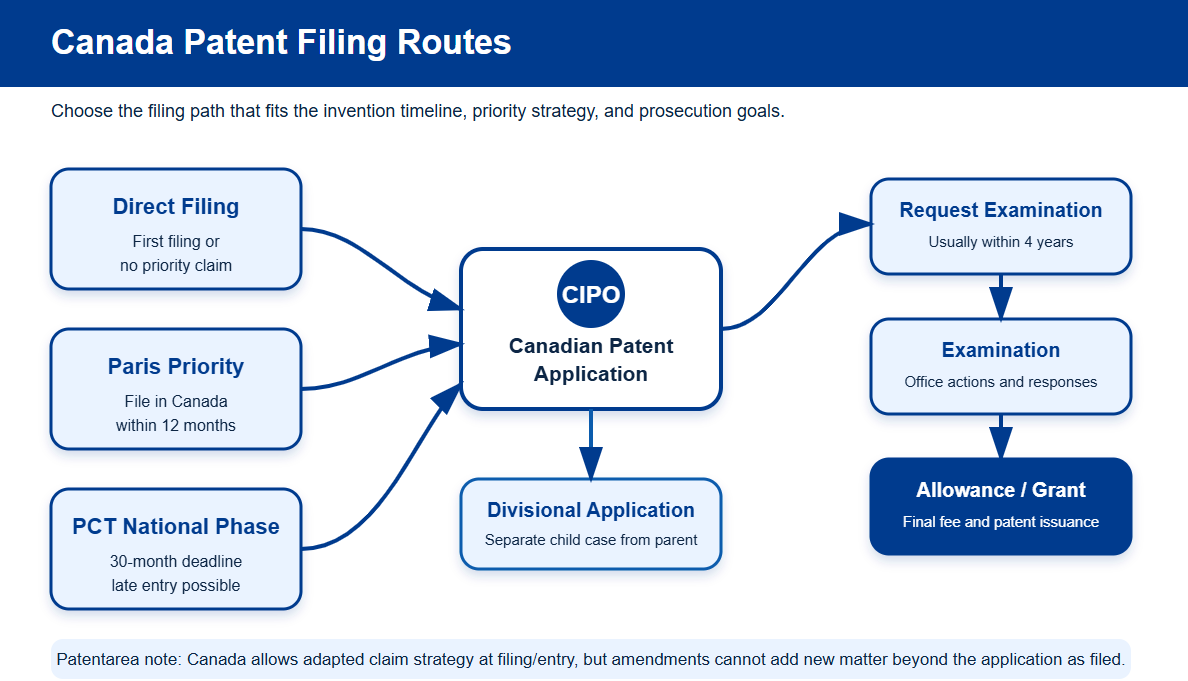
For a Canadian patent application, the main filing routes are:
| Route | Best used when |
| Direct Canadian patent application | Canada is the first filing country or no priority is claimed. |
| Paris Convention priority filing | A foreign application was filed first and Canada must be filed within the priority period. |
| PCT national phase in Canada | The applicant filed an international PCT application and wants to enter Canada. |
| Divisional application | The Canadian case must be divided from an original Canadian application, usually where multiple inventions or claim groups are involved. Canadian Patent Rules include specific divisional requirements, including a petition identifying the application as divisional and the original application number. |
Main Filing Routes: Direct Filing, Paris Convention and PCT National Phase
1. Direct Canadian Patent Application
A direct patent application in Canada may be filed as a first filing or as a non-priority national application. CIPO’s application checklist includes the petition, applicant information, statement of entitlement, inventor information, abstract, claims, description and drawings when applicable. CIPO also notes that the claims form the legal foundation that defines the invention.
2. Paris Convention Filing
If the applicant first filed in another Paris Convention country, Canada may be filed within 12 months from the first filing date to claim priority. CIPO states that Canada recognizes the earlier filing date if the Canadian application is filed within one year, or within 14 months if priority is successfully restored.
3. PCT National Phase in Canada
For a PCT national phase in Canada, the standard deadline is 30 months from the earliest priority date or, if no priority was claimed, from the international filing date. CIPO requires payment of the basic national fee, an English or French version of the international application if needed, a copy of the international application if it was not published, and any applicable maintenance fee for the second anniversary of the filing date.
4. Divisional Applications
Canada also permits divisional applications. Under the Patent Rules, a divisional application must identify itself as resulting from the division of an original Canadian application and must include at least one claim on its presentation date. Importantly, divisional applications cannot add matter beyond the original disclosure, subject to limited statutory exceptions.
Key Insight
The most common routes to file patent in Canada are direct filing, Paris Convention filing and PCT national phase entry. Divisional applications are a prosecution tool for managing multiple inventions within the Canadian system.
Documents and Formal Requirements
| Requirement |
Canada-specific note |
| Specification | Description, claims, abstract and drawings if applicable. |
| Applicant and inventor information | CIPO requires inventor information and a statement of entitlement. |
| Priority data | Required if priority is claimed. |
| Translation | English or French is required. For PCT national phase, translation is required only if the international application is not written partly in English or French. |
| Patent agent appointment | Required in several cases, including where the applicant is not the inventor. |
| Power of Attorney | A separate POA is generally not part of the standard Canadian filing package; Canada uses an agent appointment mechanism through petition or notice. |
| Small Entity Declaration | Only needed when the applicant claims small entity status for reduced fees. |
Power of Attorney and Appointment of Patent Agent
A traditional Power of Attorney is generally not required as a separate filing formality for a patent application in Canada. However, Canada does use an appointment of patent agent mechanism, through which a patent agent may be appointed to represent the applicant before the Canadian Intellectual Property Office.
This appointment may be made in the petition or through a notice submitted to the Commissioner, depending on the type of application and the filing circumstances. Therefore, for Canadian practice, the relevant formality is usually the appointment of the patent agent rather than a separate signed Power of Attorney.
For foreign applicants, the practical point is that a separate POA is typically not requested as part of the standard filing package. Instead, the Canadian agent appointment is handled through the applicable CIPO filing documents or notice procedure.
Key Insight: In Canada, a Power of Attorney and an appointment of patent agent are not technically the same. The POA is generally not required as a separate document, while the appointment of the patent agent is the mechanism used to authorize representation before CIPO.
Small Entity and Standard Entity Status
Canada has two main fee categories for patent applicants: small entity and standard entity. CIPO explains that certain fees for obtaining and maintaining a patent are reduced by 50% for small businesses and universities. Applicants should consult CIPO’s official patent fee page for the current fee amounts. A small entity is generally an entity with fewer than 100 employees or a university, but the status is not available if the applicant is controlled by a larger entity or has transferred or licensed rights to a larger entity, subject to the applicable rules. The determination is made at the filing date.
To use reduced small entity fees, the applicant must determine eligibility and submit a Small Entity Declaration before or at the time of fee payment if one is not already on file. CIPO states that the declaration only needs to be submitted once and then applies to future fee payments.
CIPO’s Small Entity Declaration Tool confirms that the declaration may be filed as part of the petition or as a separate document, but CIPO encourages filing it separately because the declaration requires a signature. The declaration must state that the applicant or patentee believes they are entitled to pay fees at the small entity level.
| Entity status | Practical implication |
| Small entity | Reduced fees may apply, but only if the applicant qualifies and a valid Small Entity Declaration is filed on time. |
| Standard entity | Applies in all other cases. CIPO’s fee page lists small entity and standard entity columns. |
Priority Claim Requirements in Canada
To claim priority in Canada, the applicant must provide the filing date, country or office of filing and application number of each earlier application on which priority is based. This requirement is set out in the Canadian Patent Act.
For a direct Canadian application claiming priority, the request for priority must generally be made in the petition or in a separate document within the prescribed period. The Patent Rules provide that the request must be filed before the earlier of: the later of 16 months from the earliest priority filing date or 4 months from the Canadian filing date, and the day after early public inspection approval if early publication is requested.
Canada also has rules for priority documents. For foreign priority claims, the applicant must submit a certified copy and filing-date certificate from the foreign patent office, or make the priority document available to CIPO through an accepted digital library. The general deadline is the latest of 16 months from the earliest priority date, 4 months from the Canadian filing date, or the PCT national phase entry date for PCT national phase applications.
For a PCT national phase entry, a priority claim made under the PCT before Canadian national phase entry is considered a request for priority in Canada.
| Item | Requirement |
| Priority period | Usually 12 months from the earliest filing date. |
| Restoration | Possible if Canada is filed within 14 months and the failure to file within 12 months was unintentional, subject to requirements. |
| Priority data | Filing date, country/office and application number. |
| Priority document | Certified copy/certificate or accepted digital library access. |
| PCT national phase | PCT priority claim generally carries into Canada if made properly before national phase entry. |
Filing with Modified Text or Amended Claims
Canada is flexible from a drafting strategy perspective. A Canadian application claiming priority does not need to be a word-for-word copy of the priority application. Similarly, a PCT national phase in Canada may be managed with a Canada-specific claim strategy, especially where claim language should be aligned with Canadian practice.
The main limitation is that new matter cannot be added after the Canadian filing baseline. CIPO emphasizes that the application forms the basis of the patent and that description, claims and drawings should be clear and complete when filed. For divisional applications, the Patent Rules expressly restrict adding matter beyond the original application disclosure.
For PPH requests, CIPO specifically notes that applicants should consider amending the application to correct informalities resulting from differences between CIPO and the Office of Earlier Examination, and that the PPH request form may be submitted with a voluntary amendment.
This is useful because in some jurisdictions a voluntary amendment must be filed as a completely separate procedural act. In Canada, the strategy can be coordinated at filing, national phase entry, request for examination or acceleration stage, although the exact electronic submission type may vary.
Key Insight
Canada allows a practical Canada-specific filing text or claim set, but amendments must remain supported by the original disclosure. This is particularly important for Canada patent voluntary amendments and PPH strategy.
Request for Examination Deadline
A Canadian patent application will not be substantively examined unless examination is requested. CIPO states that examination is not automatic and that, for most applications, the applicant has up to 4 years from the filing date to request examination. CIPO also states that no reminder is sent for the examination request deadline.
If the request is not made within the 4-year period, CIPO sends a notice and provides 2 months to request examination, pay the examination fee and pay the late fee. If the applicant still does not act in time, the application is deemed abandoned.
The examination request can be filed as early as the filing date. This may be strategically useful where the applicant wants faster prosecution, wants to combine the request with PPH or another acceleration route, or wants earlier clarity on claim scope.
Key Insight
The CIPO request for examination deadline is one of the most important Canada docketing dates. For most applications, docket 4 years from the filing date, plus the potential notice period only as a safety net.
PCT National Phase Late Entry in Canada
The standard deadline to enter the PCT national phase in Canada is 30 months from the earliest priority date or, if no priority was claimed, from the international filing date.
Canada provides an important late-entry option. If the 30-month deadline is missed, the applicant may still enter the Canadian national phase within 12 months after the deadline by meeting the national phase requirements, requesting reinstatement of rights, stating that the failure was unintentional, paying the reinstatement fee and paying the third-year maintenance fee if applicable.
This means that, in practice, Canada may allow late PCT national phase entry up to approximately 42 months from the earliest priority date, but only if the statutory requirements are satisfied. It should not be treated as an automatic extension.
Key Insight
Canada’s PCT late national phase entry is a valuable recovery mechanism. It provides an additional 12-month window after the 30-month deadline, but requires reinstatement and an unintentional-failure statement.
Accelerated Examination Options: PPH, Special Order and Green Technologies
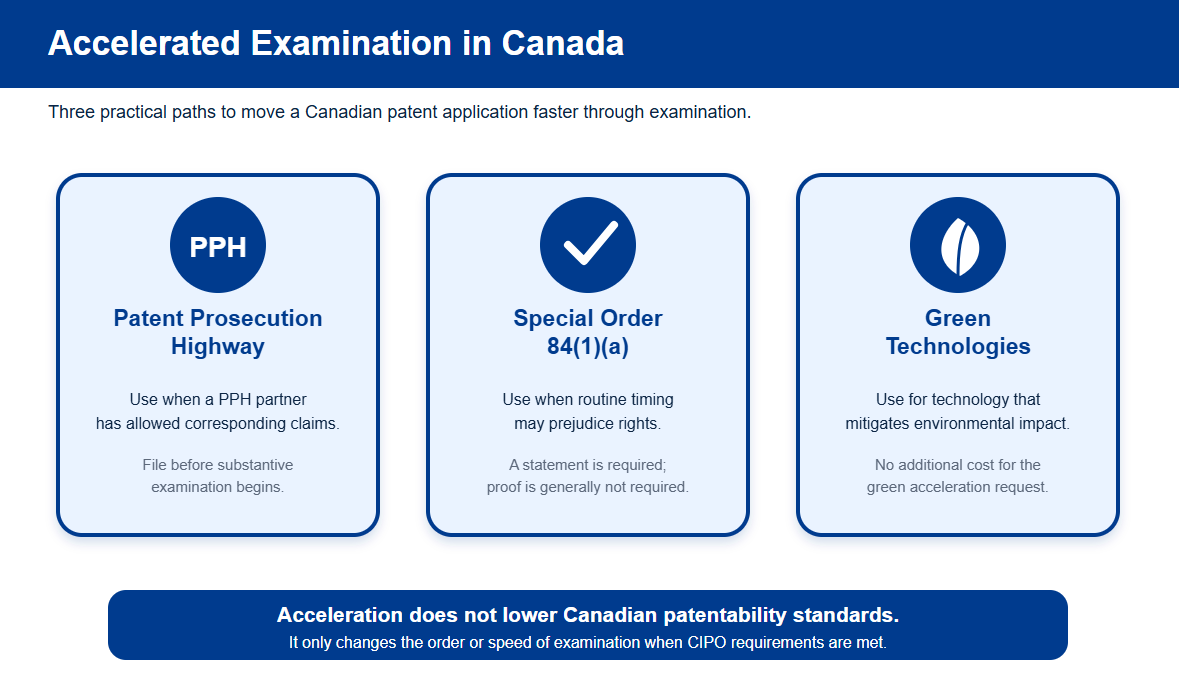
Canada offers several ways to accelerate examination. CIPO identifies multiple expedited examination routes, including PPH, advanced examination of the Patent Rules, and green technology acceleration.
| Acceleration option | When available | Main requirements | Practical use |
| Patent Prosecution Highway (PPH) | Before the first office action is issued. | A request for examination must be filed, the application must be open to public inspection, and substantive examination must not have started. The claims must correspond to allowed claims from the earlier-examining office. | Best when at least one corresponding claim has been allowed by a foreign PPH partner office and Canadian claims can be aligned. |
| Special Order / Advanced Examination | Before or after examination starts. | A written request, the applicable fee, and a statement of prejudice are required. If examination has not yet been requested, it must be requested at the same time. No evidence of actual prejudice is required. | Best when commercial rights may be harmed by delay, such as infringement concerns, funding dependency or market pressure. |
| Green Technologies | For applications relating to green technology. | If examination has not yet been requested, it must be requested with the advanced examination request. The applicant must also state that the technology could help mitigate environmental impacts or conserve the natural environment or resources. | Best for cleantech, sustainability, energy efficiency, emissions reduction, conservation and environmental technologies. |
CIPO’s current PPH guidance states that applicants should submit the PPH request without delay after receiving an indication from the Office of Earlier Examination that claims are allowable, because a first office action can issue any time after the Canadian examination request has been accepted.
For Special Order requests, once approved, CIPO states that a first office action can be expected within 7 months.
For green technologies, CIPO states that compliant requests are eligible for accelerated examination timelines and that the request can be filed at no additional cost for the green technology acceleration request itself, although the normal examination fee still applies if examination has not already been requested.
Maintenance Fees During Pendency and After Grant
Canada has a maintenance-fee rule that frequently surprises foreign applicants. Maintenance fees are not only paid after grant. CIPO states that maintenance fees must be paid for a patent or patent application every year starting on the second anniversary of the filing date.
This means maintenance fees may be due while the application is still pending. CIPO also states that no reminder will be sent, and failure to pay may result in loss of IP protection. If a maintenance fee is missed, a late fee applies, and the latest payment date is the later of 6 months after the original due date or 2 months after the Commissioner’s notice.
For PCT national phase applications, CIPO’s national phase requirements include payment of the second-anniversary maintenance fee if applicable, and late PCT entry may also require the third-year maintenance fee if applicable.
CIPO’s patent fee page should be used for current official fee amounts because the page is updated for current-year fee information and distinguishes small entity and standard entity fees.
Key Insight
In Canada, maintenance fees pending patent application Canada is a critical docketing issue. Applicants must pay annual maintenance fees during pendency and after grant.
Strengthen Your Global IP Strategy with a Canada Patent
A Canadian patent can be a valuable part of a North American and global IP portfolio. Canada offers flexible routes for direct filing, Paris Convention priority and PCT national phase in Canada, while also providing useful prosecution tools such as PPH, Special Order acceleration and green technology acceleration.
For applicants, the most important Canada-specific issues are clear: confirm small or standard entity status, do not assume a POA is required, file the Small Entity Declaration only when applicable, request examination on time, consider claim amendments early, use late PCT national phase entry only when necessary, and docket maintenance fees during pendency.
Key Insight: A successful Canada patent registration strategy is not just about filing—it is about managing timing, examination, amendments, acceleration and maintenance from day one.

Get your Patent Filed in Canada
Contact us today for a free consultation