Patent Stories: How Patents Shaped Technology
The Patent Behind the Wright Brothers’ Airplane: What Did It Really Protect?
At Patentarea, we are beginning a new series exploring some of the patents behind inventions that helped shape technological history.
Our goal with Patent Stories: How Patents Shaped Technology is not simply to revisit famous inventions or inventors. We want to look at these stories from a patent perspective: what was actually protected, how the invention was defined in the patent, how competitors responded, and what happened as the technology and the industry evolved.
Patent history can offer valuable lessons for today’s inventors and companies. The way an invention is identified, claimed, improved, licensed, or enforced can influence not only the value of a patent, but sometimes the development of an entire technological field.
We begin with one of the most recognizable inventions in modern history: the Wright brothers’ flying machine.
Interestingly, the patent application associated with this story was filed on March 23, 1903, months before the Wright brothers made their famous powered flights at Kitty Hawk in December of that year. The patent itself would not be granted until May 22, 1906.
Table of Contents
- The Invention Before the Famous Flight
- What Did the Wright Brothers Actually Patent?
- The Wright Brothers’ Patent at a Glance
- From Patent Protection to the Curtiss Dispute
- What Modern Inventors Can Learn from the Wright Brothers’ Patent
- Strengthen Your Global IP Strategy with the Right Patent Strategy
1. The Invention Before the Famous Flight
The challenge facing Wilbur and Orville Wright was not simply how to generate lift or add an engine to a flying machine. One of the fundamental problems was control.
Years before their powered flights, the brothers experimented with a technique known as wing warping. By twisting the wings so that opposite sides presented different angles to the airflow, the pilot could influence the aircraft’s lateral balance. The National Park Service describes this wing-warping concept as a forerunner of the modern aileron.
This distinction becomes particularly important when looking at their patent strategy.
On March 23, 1903, the Wright brothers filed the U.S. patent application that eventually became U.S. Patent No. 821,393, titled “Flying-Machine.” The application therefore preceded the iconic December 1903 powered flights.
The patent specification identified maintaining or restoring lateral equilibrium and guiding the machine vertically and horizontally among the principal objectives of the invention. In other words, the patent story was closely connected to solving the problem of controlled flight rather than merely putting an engine on an aircraft.
Key Insight
One of the most interesting aspects of the Wright brothers’ patent strategy is timing: they sought patent protection before the event that would make their invention famous worldwide.
2. What Did the Wright Brothers Actually Patent?
It is common to hear that “the Wright brothers patented the airplane,” but that description can be misleading.
U.S. Patent No. 821,393 did not simply claim the abstract idea of an airplane, nor was its significance limited to the exact physical configuration of the 1903 Wright Flyer.
The patent contained 18 claims. Several addressed an aircraft having lateral portions of its supporting surfaces capable of being moved into different angular relationships, allowing the two sides to interact differently with the airflow. Other claims combined this lateral-control concept with a vertical rudder and, in certain claims, a horizontal rudder.
The distinction is important.
The Wright brothers used wing warping as their practical implementation, but the specification expressly contemplated that the invention should not necessarily be limited to the exact construction illustrated in the drawings. The patent therefore attempted to capture a broader inventive concept surrounding aircraft balance and control.
This became commercially important when other aviation pioneers began developing their own control systems.
The importance of claim scope became especially clear when the Wright brothers began enforcing their patent against competing aircraft manufacturers. One of the most significant disputes involved Glenn Curtiss, whose aircraft used movable ailerons rather than the wing-warping system physically used by the Wright brothers. Although the mechanisms were not identical, both were intended to achieve lateral control of the aircraft.
This raised an important patent question: was the Wright patent limited to the particular wing-warping mechanism shown in their aircraft, or were its claims broad enough to cover other ways of achieving the same type of lateral control?
In 1914, a U.S. federal appeals court upheld the earlier decision in favor of the Wright Company. The court concluded that the Wright patent should not be interpreted narrowly around the exact wing-warping mechanism shown in the original aircraft and found that the competing Curtiss system infringed claim 3 of the patent.
The decision illustrates why patent claim scope can be commercially important. A competitor may use a different mechanical implementation and still potentially fall within a patent claim if the claim has been drafted broadly enough to cover the underlying technical concept.
That does not mean that the Wright brothers legally controlled every possible airplane. Rather, it illustrates how a patent directed toward a fundamental technical solution can reach beyond one particular prototype when its claims are drafted and interpreted accordingly.
3. The Wright Brothers’ Patent at a Glance
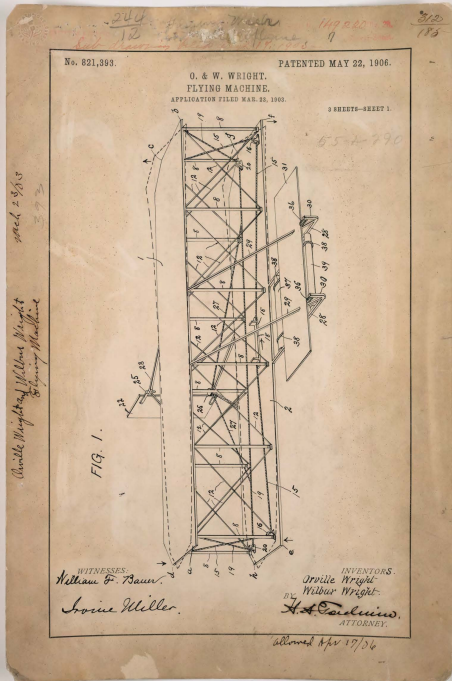
Patent: U.S. Patent No. 821,393
Title: Flying-Machine
Inventors: Orville Wright and Wilbur Wright
Application filed: March 23, 1903
Patent granted: May 22, 1906
Patent Office: United States Patent Office, now the USPTO
Number of claims: 18
Status: Expired
The patent was issued at a time when U.S. utility patents generally had a 17-year term measured from the date of grant. Accordingly, its term reached May 22, 1923. The historical 17-year rule is confirmed by the USPTO, and modern patent databases identify the Wright patent as expired.
Readers interested in seeing how this historic invention was translated into an actual patent document can review the original specification, drawings and claims here:
[Download U.S. Patent No. 821,393 – Original Patent from National Archives.gob]
The drawings themselves are worth examining. They show that a patent document can tell a different story from the finished product remembered by history: the focus is not simply what the machine looked like, but how its components cooperated to achieve the technical result.
Original Claims of U.S. Patent No. 821,393
Claim 1
In a flying-machine, a normally flat aeroplane having lateral marginal portions capable of movement to different positions above or below the normal plane of the body of the aeroplane, such movement being about an axis transverse to the line of flight, whereby said lateral marginal portions may be moved to different angles relatively to the normal plane of the body of the aeroplane, so as to present to the atmosphere different angles of incidence, and means for so moving said lateral marginal portions, substantially as described.
Claim 2
In a flying-machine, the combination, with two normally parallel aeroplanes, superposed the one above the other, of upright standards connecting said planes at their margins, the connections between the standards and aeroplanes at the lateral portions of the aeroplanes being by means of flexible joints, each of said aeroplanes having lateral marginal portions capable of movement to different positions above or below the normal plane of the body of the aeroplane, such movement being about an axis transverse to the line of flight, whereby said lateral marginal portions may be moved to different angles relatively to the normal plane of the body of the aeroplane, so as to present to the atmosphere different angles of incidence, the standards maintaining a fixed distance between the portions of the aeroplanes which they connect, and means for imparting such movement to the lateral marginal portions of the aeroplanes, substantially as described.
Claim 3
In a flying-machine, a normally flat aeroplane having lateral marginal portions capable of movement to different positions above or below the normal plane of the body of the aeroplane, such movement being about an axis transverse to the line of flight, whereby said lateral marginal portions may be moved to different angles relatively to the normal plane of the body of the aeroplane, and also to different angles relatively to each other, so as to present to the atmosphere different angles of incidence, and means for simultaneously imparting such movement to said lateral marginal portions, substantially as described.
Claim 4
In a flying-machine, the combination, with parallel superposed aeroplanes, each having lateral marginal portions capable of movement to different positions above or below the normal plane of the body of the aeroplane, such movement being about an axis transverse to the line of flight, whereby said lateral marginal portions may be moved to different angles relatively to the normal plane of the body of the aeroplane, and to different angles relatively to each other, so as to present to the atmosphere different angles of incidence, of uprights connecting said aeroplanes at their edges, the uprights connecting the lateral portions of the aeroplanes being connected with said aeroplanes by flexible joints, and means for simultaneously imparting such movement to said lateral marginal portions, the standards maintaining a fixed distance between the parts which they connect, whereby the lateral portions on the same side of the machine are moved to the same angle, substantially as described.
Claim 5
In a flying-machine, an aeroplane having substantially the form of a normally flat rectangle elongated transversely to the line of flight, in combination with means for imparting to the lateral margins of said aeroplane a movement about an axis lying in the body of the aeroplane perpendicular to said lateral margins, and thereby moving said lateral margins into different angular relations to the normal plane of the body of the aeroplane, substantially as described.
Claim 6
In a flying-machine the combination, with two superposed and normally parallel aeroplanes, each having substantially the form of a normally flat rectangle elongated transversely to the line of flight, of upright standards connecting the edges of said aeroplanes to maintain their equidistance, those standards at the lateral portions of said aeroplanes being connected therewith by flexible joints, and means for simultaneously imparting to both lateral margins of both aeroplanes a movement about axes which are perpendicular to said margins and in the planes of the bodies of the respective aeroplanes, and thereby moving the lateral margins on the opposite sides of the machine into different angular relations to the normal planes of the respective aeroplanes, the margins on the same side of the machine moving to the same angle, and the margins on one side of the machine moving to an angle different from the angle to which the margins on the other side of the machine move, substantially as described.
Claim 7
In a flying-machine, the combination, with an aeroplane, and means for simultaneously moving the lateral portions thereof into different angular relations to the normal plane of the body of the aeroplane and to each other, so as to present to the atmosphere different angles of incidence, of a vertical rudder, and means whereby said rudder is caused to present to the wind that side thereof nearest the side of the aeroplane having the smaller angle of incidence and offering the least resistance to the atmosphere, substantially as described.
Claim 8
In a flying-machine, the combination with two superposed and normally parallel aeroplanes, upright standards connecting the edges of said aeroplanes to maintain their equidistance, those standards at the lateral portions of said aeroplanes being connected therewith by flexible joints, and means for simultaneously moving both lateral portions of both aeroplanes into different angular relations to the normal planes of the bodies of the respective aeroplanes, the lateral portions on one side of the machine being moved to an angle different from that to which the lateral portions on the other side of the machine are moved, so as to present different angles of incidence at the two sides of the machine, of a vertical rudder, and means whereby said rudder is caused to present to the wind that side thereof nearest the side of the aeroplanes having the smaller angle of incidence and offering the least resistance to the atmosphere, substantially as described.
Claim 9
In a flying-machine, an aeroplane normally flat and elongated transversely to the line of flight, in combination with means for imparting to said aeroplane a helicoidal warp around an axis transverse to the line of flight and extending centrally along the body of the aeroplane in the direction of the elongation of the aeroplane, substantially as described.
Claim 10
In a flying-machine, two aeroplanes, each normally flat and elongated transversely to the line of flight, and upright standards connecting the edges of said aeroplanes to maintain their equidistance, the connections between said standards and aeroplanes being by means of flexible joints, in combination with means for simultaneously imparting to each of said aeroplanes a helicoidal warp around an axis transverse to the line of flight and extending centrally along the body of the aeroplane in the direction of the elongation of the aeroplane, substantially as described.
Claim 11
In a flying-machine, two aeroplanes, each normally flat and elongated transversely to the line of flight, and upright standards connecting the edges of said aeroplanes to maintain their equidistance, the connections between such standards and aeroplanes being by means of flexible joints, in combination with means for simultaneously imparting to each of said aeroplanes a helicoidal warp around an axis transverse to the line of flight and extending centrally along the body of the aeroplane in the direction of the elongation of the aeroplane, a vertical rudder, and means whereby said rudder is caused to present to the wind that side thereof nearest the side of the aeroplanes having the smaller angle of incidence and offering the least resistance to the atmosphere, substantially as described.
Claim 12
In a flying-machine, the combination, with an aeroplane, of a normally flat and substantially horizontal flexible rudder, and means for curving said rudder rearwardly and upwardly or rearwardly and downwardly with respect to its normal plane, substantially as described.
Claim 13
In a flying-machine, the combination, with an aeroplane, of a normally flat and substantially horizontal flexible rudder pivotally mounted on an axis transverse to the line of flight near its center, springs resisting vertical movement of the front edge of said rudder, and means for moving the rear edge of said rudder above or below the normal plane thereof, substantially as described.
Claim 14
A flying-machine comprising superposed connected aeroplanes, means for moving the opposite lateral portions of said aeroplanes to different angles to the normal planes thereof, a vertical rudder, means for moving said vertical rudder toward that side of the machine presenting the smaller angle of incidence and the least resistance to the atmosphere, and a horizontal rudder provided with means for presenting its upper or under surface to the resistance of the atmosphere, substantially as described.
Claim 15
A flying-machine comprising superposed connected aeroplanes, means for moving the opposite lateral portions of said aeroplanes to different angles to the normal planes thereof, a vertical rudder, means for moving said vertical rudder toward that side of the machine presenting the smaller angle of incidence and the least resistance to the atmosphere, and a horizontal rudder provided with means for presenting its upper or under surface to the resistance of the atmosphere, said vertical rudder being located at the rear of the machine and said horizontal rudder at the front of the machine, substantially as described.
Claim 16
In a flying-machine the combination, with two superposed and connected aeroplanes, of an arm extending rearward from each aeroplane, said arms being parallel and free to swing upward at their rear ends, and a vertical rudder pivotally mounted in the rear ends of said arms, substantially as described.
Claim 17
A flying-machine comprising two superposed aeroplanes, normally flat but flexible, upright standards connecting the margins of said aeroplanes, said standards being connected to said aeroplanes by universal joints, diagonal stay-wires connecting the opposite ends of the adjacent standards, a rope extending along the front edge of the lower aeroplane, passing through guides at the front corners thereof, and having its ends secured to the rear corners of the upper aeroplane, and a rope extending along the rear edge of the lower aeroplane, passing through guides at the rear corners thereof, and having its ends secured to the front corners of the upper aeroplane, substantially as described.
Claim 18
A flying-machine comprising two superposed aeroplanes, normally flat but flexible, upright standards connecting the margins of said aeroplanes, said standards being connected to said aeroplanes by universal joints, diagonal stay-wires connecting the opposite ends of the adjacent standards, a rope extending along the front edge of the lower aeroplane, passing through guides at the front corners thereof, and having its ends secured to the rear corners of the upper aeroplane, and a rope extending along the rear edge of the lower aeroplane, passing through guides at the rear corners thereof, and having its ends secured to the front corners of the upper aeroplane, in combination with a vertical rudder, and a tiller-rope connecting said rudder with the rope extending along the rear edge of the lower aeroplane, substantially as described.
4. From Patent Protection to the Curtiss Dispute
As aviation developed, patent protection became part of the competition between the Wright interests and other aircraft pioneers, most notably Glenn Curtiss.
The Wright Company pursued infringement proceedings against the Herring-Curtiss Company and Glenn Curtiss based on U.S. Patent No. 821,393. The litigation centered on whether competing aircraft control arrangements fell within the Wright patent claims.
The dispute is significant because competitors did not necessarily need to build a physical copy of the Wright Flyer for patent infringement to become an issue. The legal question was whether the relevant features of their aircraft came within the scope of the patented claims.
Following extensive proceedings, the Second Circuit affirmed the validity of the Wright patent in January 1914 and found infringement.
The consequences extended beyond the two competitors. The National Park Service identifies the Wright-Curtiss patent conflict, together with the limited market for aircraft, as one factor that held back technological development in the United States relative to Europe during the period before World War I.
With the United States preparing its aviation industry for World War I, the industry eventually established the Manufacturers Aircraft Association, creating a patent pool through which participating manufacturers could use relevant aviation patents. Smithsonian records describe this arrangement as allowing participants to use patents needed to build aircraft for the war effort.
The story therefore moved from invention, to patent protection, to enforcement, and ultimately to collective licensing as an emerging industry confronted the practical consequences of overlapping patent rights.
5. What Modern Inventors Can Learn from the Wright Brothers’ Patent
More than a century later, U.S. Patent No. 821,393 still provides several useful lessons for inventors and companies.
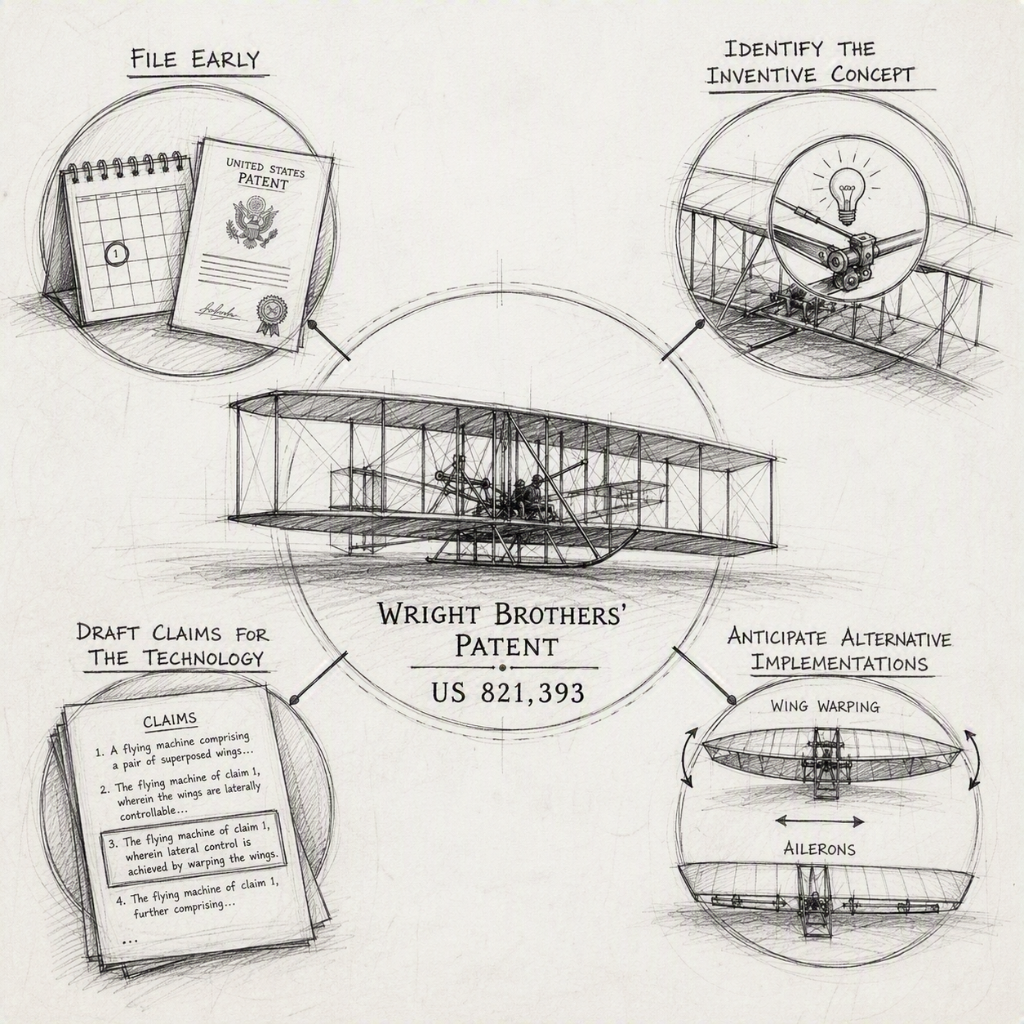
First, patent timing can be critical. The Wright brothers filed their application before the public event that ultimately made their invention famous.
Second, identifying the real inventive concept matters. The lasting importance of their patent was not simply the appearance of one particular aircraft. The claims focused heavily on the technical problem of maintaining and controlling equilibrium.
Third, the relationship between the specification and the claims can influence how a patent responds to technological variations. The Wright specification did not attempt to confine every aspect of the invention to the precise construction shown in the drawings.
Finally, a commercially important patent exists within a competitive environment. Competitors may develop alternative technical solutions, challenge the scope or validity of the patent, negotiate licenses, or attempt to design around the protected technology.
This historical example complements a principle we recently discussed in our article How Patent Drafting Can Affect the Protection of a Revolutionary Invention: technological importance alone does not determine the scope of patent protection. How the invention is captured in the patent application can have consequences long after the first prototype is built.
Key Insight
A revolutionary invention and a valuable patent are not necessarily the same thing. Patent strategy requires identifying, describing and claiming the technical contribution that may remain commercially relevant as the technology evolves.
Strengthen Your Global IP Strategy with the Right Patent Strategy
The Wright brothers’ story illustrates how patent protection can become part of the technological and commercial history of an invention.
For modern inventors and companies, the same fundamental challenge remains: identifying the core inventive concept, preparing a patent application that supports an appropriate scope of protection, and coordinating filings with the markets in which the technology may ultimately have commercial value.
Patentarea assists inventors, companies and IP attorneys with patent drafting, international patent filing, PCT national phases and global patent portfolio strategies across multiple jurisdictions.
A strong invention starts with technology. Building meaningful patent protection around it requires strategy.

Get your Patent Drafted Properly
Contact us today for a free consultation